
Finance Edition: 2026 Privacy Benchmarking Report
- Incident volume declined, but risk did not. Finance saw a 5.04% decrease in reported incidents, signaling improved controls but not reduced exposure.
- Third-party incidents remain the defining risk. External events are ~6× more likely to result in a breach than internal ones.
- Notification performance is improving, but still lags. 25.7% of notifications were overdue, higher than in other industries despite year-over-year progress.
Jump to Section
Fewer Incidents, Narrower Margin for Error
Financial services stand apart from other industries in this year’s Privacy Benchmarking Report. While healthcare and other sectors continue to see rising incident volumes, finance experienced a 5.04% decline year-over-year.
But this reduction does not directly translate into lower risk.
Instead, it reflects a shift: risk in financial services is no longer driven by volume, but by impact. In finance, fewer incidents mean:
- Each event carries greater regulatory and reputational weight
- There is less tolerance for inconsistency or error
- Outliers, particularly high-impact incidents, have a disproportionate effect
The result is a narrower margin for error. Privacy teams are not simply managing fewer incidents. They are operating in an environment where every incident matters more.
Third-Party Risk Is the Center of Gravity
The most defining characteristic of privacy risk in finance is its external concentration.
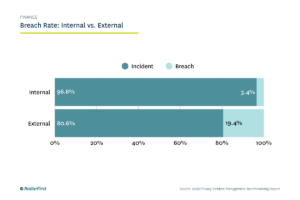
- Internal incidents convert to breaches at just 3.45%
- External incidents jump to 19.38%, nearly 6× higher
This aligns with broader industry trends, where third-party incidents are low-frequency but high-severity, but the effect is especially pronounced in finance. Financial institutions have largely optimized internal controls, but risk has shifted beyond organizational boundaries.
Third-party vendors, processors, and service providers now represent:
- The least visible source of incidents
- The most likely source of escalation
- The hardest to control through traditional internal processes
Organizations may feel operationally mature internally, while remaining highly exposed externally.
Implication:
Privacy risk in finance is not contained within the organization. It is distributed across an extended ecosystem. Effective incident management must therefore evolve from internal control to external coordination, vendor oversight, and consistent cross-boundary decision-making.
Risk Is Increasingly Concentrated in Electronic Channels
In financial services, incident patterns are increasingly shaped by electronic sources, which account for the largest share of incidents, while paper (on the decline for the third consecutive year) and verbal/visual disclosures remain comparatively limited.
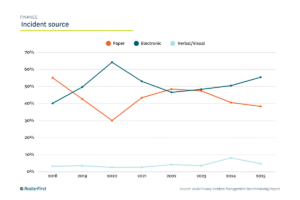
Electronic incidents are more likely to involve interconnected systems, larger datasets, and faster propagation across business units and third parties. In a highly digital and integrated environment like finance, this increases both the speed and potential scale of exposure.
Implication:
Privacy risk in finance is becoming more system-driven than people-driven. As a result, organizations must prioritize consistent intake, rapid triage, and structured assessment for electronic incidents, where small failures can escalate quickly.
Speed Is High But Deadlines Are Harder
Financial services organizations are operating with a high degree of efficiency. On average, they move from discovery to notification in 18.0 days, outperforming the overall industry benchmark.
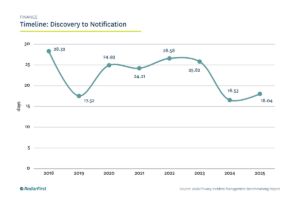
This reflects years of investment in:
- Streamlined workflows
- Automation and tooling
- Operational discipline across privacy and compliance teams
However, speed alone does not guarantee success.
Despite faster response times, 25.7% of notifications in finance are still overdue.
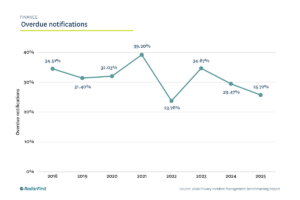
This gap highlights a structural challenge unique to the industry. Financial services organizations often operate under significantly shorter regulatory deadlines, sometimes as little as 72 hours. Even well-run teams are operating with:
- Less time to investigate and validate incidents
- Less room for iterative or collaborative decision-making
- Higher exposure to penalties for timing missteps
25.7% overdue notifications; higher than healthcare and insurance, but improving for the second consecutive year.
Implication:
In finance, performance is not defined by speed alone. It is defined by the ability to make accurate, defensible decisions within compressed timeframes. Execution must be both fast and precise; there is little tolerance for either delay or error.
Lower Notification Rates, Higher Decision Pressure
Compared to other industries, financial services reports a relatively low percentage of incidents requiring notification: 4.17% of incidents are notifiable.
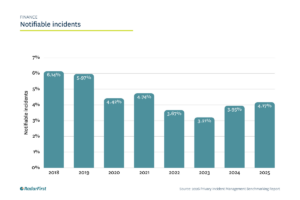
On the surface, this suggests a lower regulatory burden. But the reality is more nuanced.
When fewer incidents clearly meet notification thresholds, the challenge shifts from execution to judgment:
- Determining whether an incident is reportable becomes more complex
- Small variations in interpretation can lead to inconsistent outcomes
- Decisions are more likely to be scrutinized after the fact
This is where many organizations face risk, not in missing incidents, but in how they classify and respond to them. We can not stress enough that consistency is key here.
Implication:
In finance, privacy risk is increasingly defined by the quality of decisions. Organizations must ensure that:
- Similar incidents are assessed consistently.
- Decisions are documented and defensible.
- Judgment can scale across teams and incident volumes.
Summary
Financial services are operating in a more controlled but also more exposed risk environment. While incident volume has declined, risk has shifted toward external dependencies and electronic systems, where incidents are less frequent but more likely to escalate.
At the same time, compressed regulatory timelines and lower notification rates increase pressure on decision-making. Success depends on making consistent, defensible decisions under tight deadlines.
To stay in control and audit-ready, privacy teams need more than process; they need structured, repeatable workflows supported by purpose-built tools like Radar Privacy to ensure consistency, documentation, and defensibility at scale.
Bottom line:
Risk in finance is defined by impact, not volume, requiring precise and scalable incident management.
—–
Download full report 2026 Privacy Benchmarking Report.
Related Posts
Insights on Privacy, AI Risk, and Compliance

Let’s Get Started
Trusted by leading organizations, RadarFirst enables teams to manage incidents with speed, consistency, and defensibility by standardizing how incidents are captured, assessed, and actioned.
