
Healthcare Edition: 2026 Privacy Benchmarking Report
- Incident volume continues to rise. Healthcare saw a 15.62% increase in incidents, the highest among all industries.
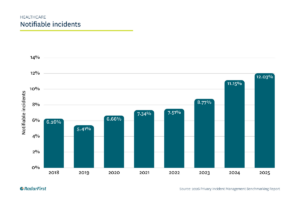
- Notifiable incidents are increasing year over year. The rate reached 12.03% in 2025.
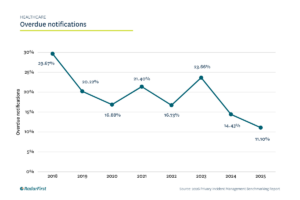
- Overdue notifications show a significant downward trend, decreasing from ~23% to 11% over the past two years.
Jump to Section
Fewer Incidents, Persistent Exposure
Healthcare stands apart as the only industry experiencing significant growth in incident volume (+15.62%)
This increase reflects a combination of factors:
- Highly sensitive data environments
- Complex care delivery workflows
- Expanding regulatory expectations
As volume grows, the challenge is not just identifying incidents but managing them consistently at scale. Even though most incidents are low-impact individually, the cumulative operational burden is significant.
Third-Party Risk: Low Frequency, High Severity
While most healthcare incidents originate internally, external incidents are far more likely to result in a breach.
- Internal breach rate: ~11.4%
- External breach rate: ~27.6%, more than 2× higher

This pattern is consistent across industries, where external incidents represent a small share of total volume (~4.8%) but account for a disproportionate share of notifiable breaches. Compared to finance and insurance, where external incidents are nearly 6× more likely to escalate, healthcare shows a lower relative gap, but a higher absolute breach rate overall, reflecting the sensitivity and regulatory weight of healthcare data.
While external incidents represent a small share of total volume, they are far more likely to escalate into reportable breaches. This mirrors the broader trend where third-party incidents account for a disproportionate share of serious compliance events.
Implication:
Third-party incidents remain the highest-impact risk category across all industries. In healthcare, even with stronger internal exposure, external events still carry the greatest escalation risk, reinforcing the need for robust vendor oversight and consistent cross-organizational response.
Incident Source: Internal Complexity Drives Risk
Healthcare shows a distinct incident profile compared to other industries, with a significantly higher share of internal incidents.
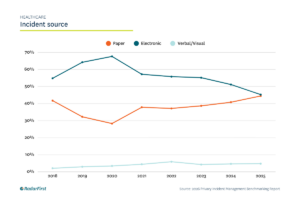
While electronic incidents represent a large share of activity, paper-based incidents remain elevated relative to other industries, reflecting the continued use of physical documentation and distributed workflows. Verbal and visual disclosures also persist as a measurable source of incidents.
This mix highlights a key challenge: risk in healthcare is often tied to people, processes, and environment, not just systems.
Year-over-year, paper-based incidents in the healthcare industry are rising, while electronic-based incidents are declining.
Implication:
Privacy risk in healthcare is driven by operational complexity. Organizations must ensure consistent intake and assessment across a wide range of incident types, including those that originate from human error and manual processes.
Speed and Compliance: Leading Performance
Healthcare organizations demonstrate strong performance in breach response timelines, with consistent progress over time.
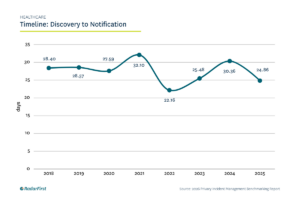
At the same time, healthcare leads in on-time notification performance. 11.1% overdue notifications result is the lowest across industries. This advantage is partly influenced by longer regulatory timelines (often 30–45 days), but also reflects mature operational processes and consistent execution.
Implication:
Healthcare organizations have built strong capabilities in managing timelines, but must sustain this performance as incident volume continues to grow
Notifiable Incidents: Higher Rates, Clearer Thresholds
Healthcare reports the highest share of notifiable incidents, reaching 12.03% in 2025, with a steady upward trend over time.
This reflects:
- Stricter regulatory requirements
- Broader definitions of reportable incidents
- Greater sensitivity of healthcare data
Unlike industries with lower notification rates, healthcare benefits from clearer thresholds, where incidents more consistently meet reporting criteria.
Implication:
Higher notification rates increase regulatory workload, but reduce ambiguity. The focus shifts from classification to efficient execution and compliance at scale.
Summary
Healthcare operates in a high-volume, high-complexity risk environment. Incident volume continues to rise, driven by operational complexity and sensitive data flows, while internal processes remain the primary source of incidents.
At the same time, strong performance in timelines and notification compliance reflects growing operational maturity. However, sustaining this performance at increasing scale remains the central challenge.
To stay in control and audit-ready, privacy teams need more than process; they need structured, repeatable workflows supported by purpose-built tools like Radar Privacy to ensure consistency, documentation, and defensibility across high volumes of incidents.
Bottom line: Risk in healthcare is defined by scale and complexity, requiring operational discipline and scalable incident management to maintain control.
Download full report 2026 Privacy Benchmarking Report.
Related Posts
Insights on Privacy, AI Risk, and Compliance

Let’s Get Started
Trusted by leading organizations, RadarFirst enables teams to manage incidents with speed, consistency, and defensibility by standardizing how incidents are captured, assessed, and actioned.
