
The CFO’s Guide to the Hidden Costs of Manual Privacy Incident Response
Jump to Section
For CFOs, privacy incident response is not only a compliance function. It is a recurring operating cost that can quietly expand through manual assessment work, outside counsel review, regulatory tracking, and delayed decision-making.
When privacy, legal, and compliance teams rely on spreadsheets, email, and manual interpretation, the financial impact is often hard to see in one place. But the cost is real: skilled employees spend hours assessing incidents, legal teams validate repeatable decisions, and organizations carry the risk of inconsistent or poorly documented response processes.
This guide breaks down where manual privacy incident response creates hidden cost, how to model the financial impact, and how automation can help organizations make faster, more consistent, and more defensible decisions.
Why Manual Privacy Incident Response Creates Hidden Costs
Manual privacy incident response creates cost leakage in three common areas: internal assessment time, outside counsel review, and regulatory change tracking.
First, privacy and legal teams spend valuable time gathering facts, interpreting notification obligations, and documenting decisions. Second, organizations often turn to outside counsel to validate repeatable determinations that could be handled more consistently with a structured decisioning process. Third, teams must continuously monitor changing breach notification requirements across jurisdictions.
For CFOs, the issue is not only the cost of each individual incident. It is the recurring operational drag that arises when every incident requires manual coordination, interpretation, and documentation.
The longer teams rely on manual workflows, the longer the organization continues to absorb avoidable assessment, validation, and regulatory tracking costs.
What Manual Incident Response Can Cost Each Month
The financial impact of manual privacy incident response depends on incident volume, labor rates, legal review needs, and regulatory complexity. The example below shows how recurring costs can accumulate in a monthly operating model.
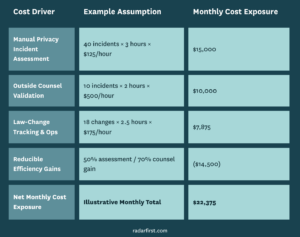
This model is illustrative, not universal. A stronger business case should use your organization’s actual incident volume, internal labor costs, outside counsel rates, and current regulatory monitoring workload.
What Financial Return Can Automation Deliver?
Automating privacy incident response can reduce avoidable operating costs by helping teams assess incidents more quickly, apply regulatory intelligence more consistently, and document decisions within a defensible workflow.
In RadarFirst’s illustrative ROI model, these savings are driven by three operational improvements:
- Recaptured time: reduced manual effort during incident assessment
- Legal optimization: lower dependence on outside counsel for repeatable validation work
- Regulatory intelligence: less manual effort required to monitor and apply changing breach notification requirements
Based on the assumptions used in the model, automation may deliver a 308% ROI, a 3.7-month payback period, and a five-year NPV of $1.46M.
The Cost of Waiting
Manual processes do not only create direct labor and legal costs. They also create a waiting cost when organizations delay evaluation of a more structured incident response process.
Using the illustrative monthly exposure above, a standard three-month evaluation delay could represent approximately $67,125 in avoidable operating expense. That figure should be adjusted based on your organization’s incident volume, legal review patterns, and internal labor rates.
For CFOs, this makes the timing of the evaluation part of the financial case. The longer teams rely on manual workflows, the longer the organization continues to absorb avoidable assessment, validation, and regulatory tracking costs.
How CFOs Can Build a Defensible Business Case
A defensible business case for privacy incident response automation should be grounded in the organization’s actual operating model. CFOs should evaluate:
- monthly privacy incident volume
- average assessment time per incident
- blended hourly cost for privacy, legal, and compliance teams
- outside counsel review frequency and hourly rates
- time spent monitoring regulatory changes
- expected efficiency gains from structured workflows
- implementation cost and time to value
This approach gives finance leaders a clearer view of where money is going today and where automation can reduce avoidable expenses without compromising diligence or legal oversight.
Summary
Manual privacy incident response can create a recurring financial burden through internal assessment time, outside counsel validation, regulatory tracking, and delayed decision-making. For finance leaders, these costs are often difficult to see because they are distributed across privacy, legal, compliance, and operations teams.
A structured, automated approach helps organizations reduce avoidable manual work, improve consistency, and create stronger documentation for defensible decisions. Using RadarFirst’s illustrative model, a three-month evaluation delay could represent approximately $67,125 in avoidable operating expense.
To build a more accurate business case, CFOs should model their own incident volume, labor rates, counsel spend, and regulatory monitoring effort.
Ready to quantify the financial impact of manual privacy incident response?
- Read the full white paper: The Hidden Cost of Manual Privacy Management
- Build your custom business case: Interactive ROI Calculator
Related Posts
Insights on Privacy, AI Risk, and Compliance

Let’s Get Started
Trusted by leading organizations, RadarFirst enables teams to manage incidents with speed, consistency, and defensibility by standardizing how incidents are captured, assessed, and actioned.
