Recent Resource

Industry Report
Taking Uncertainty out of Privacy Incident Response
→ A Unified Framework for Privacy Incident Response
→ Pre-incident Preparation
→ Incident Intake and Escalation
→ Incident Risk Assessment and Decision
→ Breach Notification
→ Post-incident Reporting and Trend Analysis
→ Additional Resources
From the U.S. and the EU to Brazil and Malaysia, nations and states are enacting both general and industry-specific privacy regulations. Mandated response times for data breaches are becoming shorter and shorter, despite evolving and disjointed definitions of sensitive information, accountability, ownership of information, and even what constitutes a breach.
We face a growing number of incidents and threats due to the proliferation of data in our business operations. However, privacy teams struggle to secure internal commitment and resources, often having to allocate from or borrow against non-privacy budget areas, such as security.
To stay compliant in this chaotic environment, you need an incident response process that takes inefficiency and guesswork out of the equation.
To optimize resource utilization and prevent missteps, a unified incident response framework is necessary. This framework should enable continuous information flow from incident discovery through post-incident tracking, leveraging automation and analytics to ensure speed and consistency. Additionally, it should integrate IR with other organizational processes and tools.
Some organizations are just finding their way with formalized incident response processes, but even mature privacy programs have areas for improvement. No matter where your organization is on the continuum, this guide is a tool to help you assess each stage of your IR process and identify areas and strategies for improvement.
In the following pages, we’ll provide an overview of each phase of the incident response process, followed by a checklist to assess whether your organization is executing that phase consistently, effectively, and efficiently, along with possible steps to address performance gaps.

A unified incident response process has well-defined phases, each with clear objectives. Consistent, repeatable processes and the right tools to support each phase will help ensure consistency, accelerate decision-making time, eliminate the risk of over- and under-reporting, and help your organization stay current and compliant with the changing regulatory landscape.
An incident is detected by InfoSec or reported by an internal or external source. The clock is ticking for the IR team to investigate the incident, involve appropriate stakeholders, and capture enough information to drive an accurate risk assessment.
Using information gathered during the intake phase, the IR team must accurately determine whether notification to regulators and/or individuals is required based on all applicable regulations in different nations and states.
If notification is required, the IR team must notify regulators and individuals of the breach in time to meet all regulatory deadlines. Notifications must contain the required information for each jurisdiction, and their delivery must be tracked and documented.
Ongoing analysis is critical to maintaining security and demonstrating your commitment to regulators. Incident sources and severity, consistency of the risk assessment process, and other indicators should be tracked over time and used to pinpoint problems and improve privacy and security processes.
Effective incident response depends as much on what you do before an incident as what happens after.
You need an incident response team that’s trained and ready to swing into action. You need clear, simple policies, processes, and reporting mechanisms, so that everyone in your organization, from the privacy team to line staff, knows how to identify an incident and what to do next. And you need a culture of privacy protection and awareness, so that staff are on the lookout for problems.
Everyone, from the executive suite to the privacy and infosec teams, on to line staff and, ideally, business partners.
The entire organization is educated about data security and incident response and committed to a culture of privacy.
Here are some actions successful privacy programs are taking for improvement:
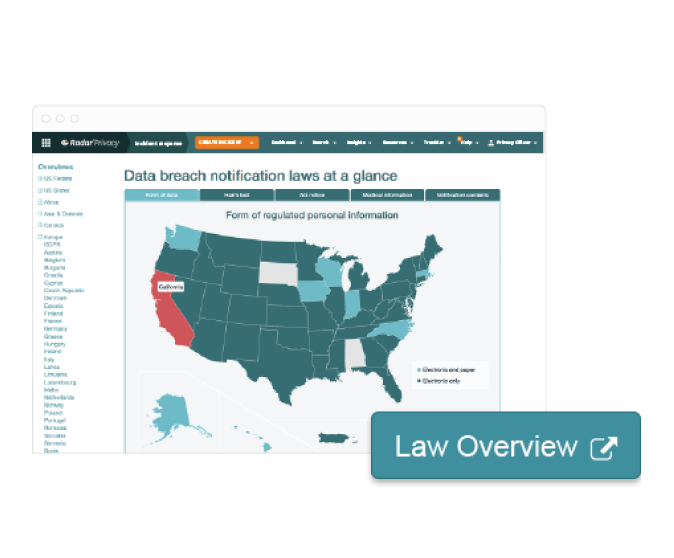

Effective incident response depends on what you do before an incident, not just what happens after.
Newer regulations have set daunting notification requirements. Under laws such as GDPR, organizations have as little as 72 hours to notify regulators of a possible breach, so incident response processes need to escalate and investigate incidents faster than ever before. This requires a reporting and escalation process that is both simple to use and streamlined, while also gathering sufficient, accurate information to support the notification decision.
Core incident response team (privacy, infosec, compliance) reporting staff member or department, forensics.
Here are some actions successful privacy programs are taking for improvement:
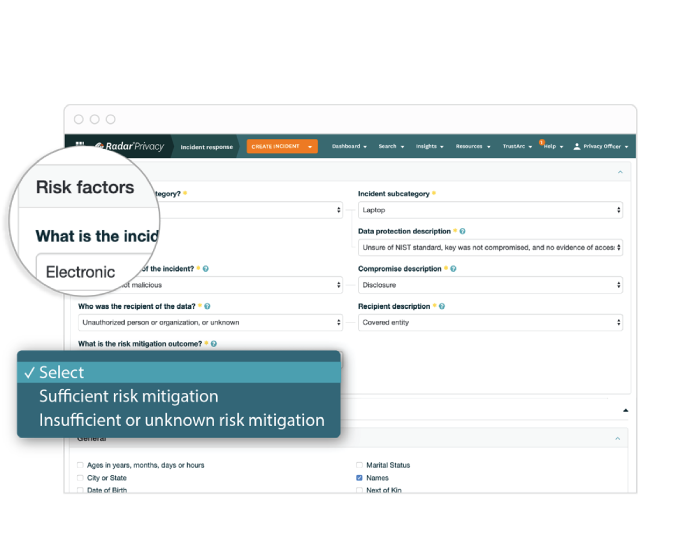

The ability to demonstrate a consistent approach is a critical factor in making defensible notification decisions to regulators.
But consistency is challenging. Besides the human factor, differing perceptions of risk within the privacy team, you must deal with the patchwork of global data breach laws, each with different definitions of data breach, personal data, exceptions, notification thresholds, and notification timelines.
When an incident involves the sensitive data of individuals from multiple regions of the globe, your risk assessment process must be consistent, efficient, and effective according to all applicable laws to ensure compliance and avoid over- or under-reporting.
The core incident response team (IRT), counsel, marketing/PR, and finance.
Here are some actions successful privacy programs are taking for
improvement:
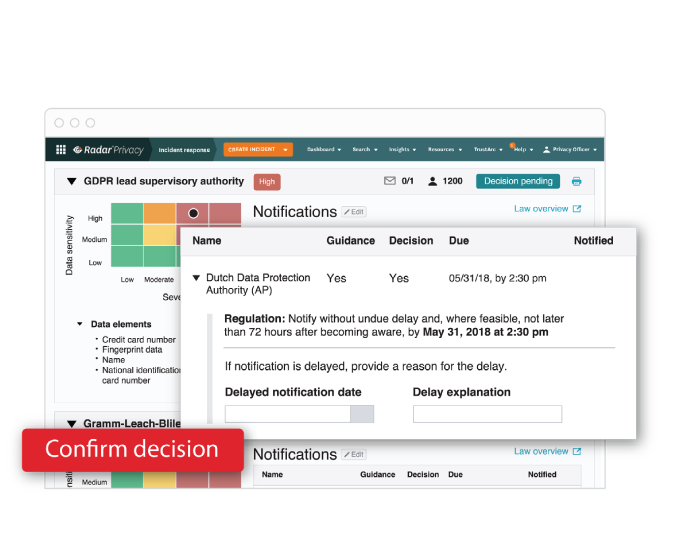

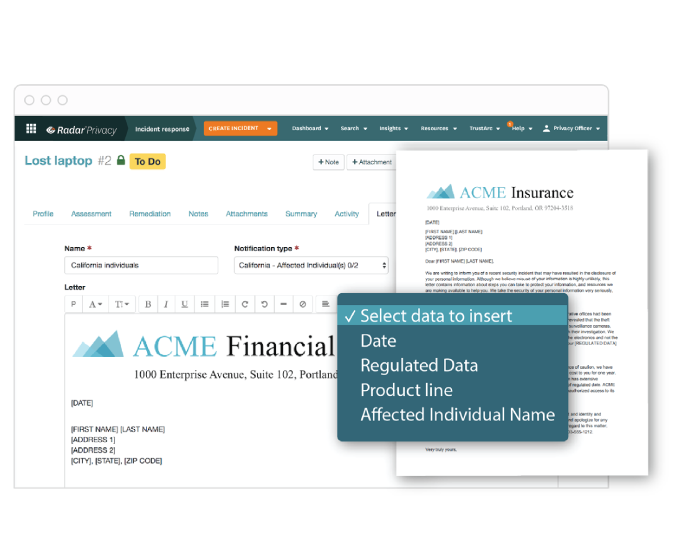
If you determine that notification is required, your privacy and legal teams must be prepared to quickly generate notification letters to individuals, regulatory agencies, and data protection authorities, as well as track responses and document their efforts.
They must also maintain counsel-approved notification letter templates, ensuring each notice meets regulatory, contractual, and strategic requirements of your organization.
The core incident response team (IRT), counsel, marketing and communications and finance.
Here are some actions successful privacy programs are taking for improvement:
Review notification templates regularly to ensure that they meet
evolving regulatory requirements.

The time after an incident is also the time before the following incident—time you can use to evaluate and improve your incident response process and to pinpoint and fix gaps.
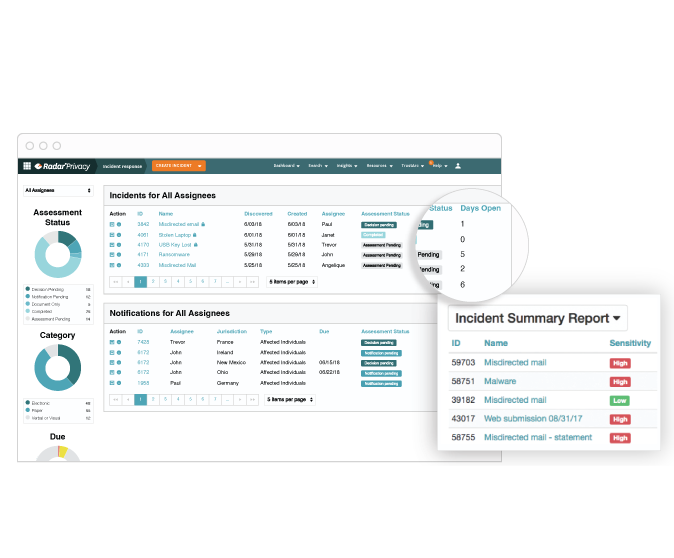
Identify areas where the process could be accelerated. Analyze past incidents to identify causes, factors, and problem areas. Look at incident response metrics to see whether you’re consistently meeting regulatory deadlines and to see whether you’re tending to over- or under-report. And don’t forget to measure and celebrate successes and improvements. Take the opportunity to highlight your progress and convey your ongoing needs to your executive leadership and Board.
Core incident response team (IRT), privacy team, infosec, HR/training, executive team (informed).
Here are some actions successful privacy programs are taking for improvement:
How you do incident response is vitally important, not only for compliance but for protecting your customers and your organization. Whether your organization, your privacy team, and your resources are large or small, you need to strive for an IR process that is fast, efficient, and leads to decisions that are defensible to regulators and effective at protecting affected individuals. You can’t prevent every incident or breach, but with commitment and the right tools, you can use each one as an opportunity to improve.
Access this free library of hundreds of global privacy laws, rules, and regulations to stay current on existing and proposed legislation.
Access the Regulatory Law Overviews »
Get in-depth information on key regulations such as CCPA, GDPR, PIPEDA, and Australia’s Notification Data Breaches scheme. Includes comparison guides.
Access the Guides »
Radar Privacy offers one tool to guide you through all 10 stages of incident management. Accelerate breach resolution from discovery to notification and beyond with a single solution that documents all your incident management actions and reporting.
Assess an Incident »