Recent Resource

Radar AI Incident Management
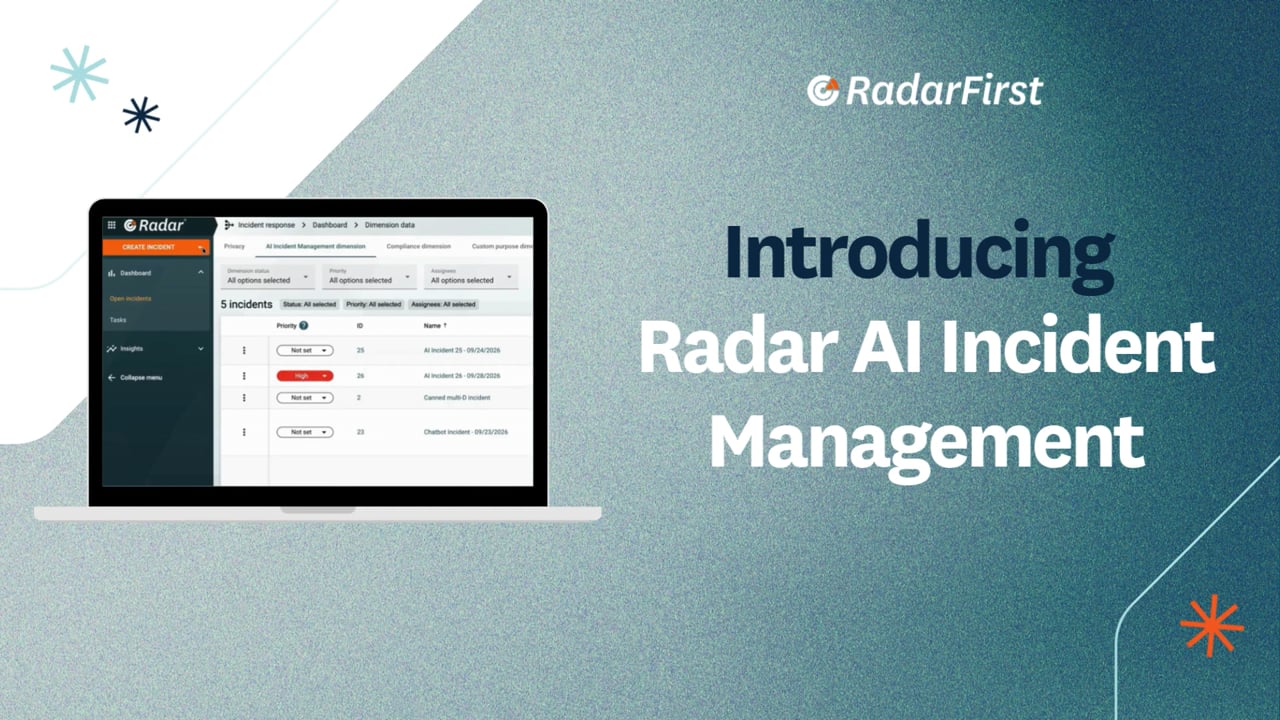
RadarFirst gives teams a purpose-built, repeatable way to investigate AI incidents, assess potential impact, coordinate response, and document every decision with consistency, accountability, and traceability.
Organizations know how to respond to cybersecurity and privacy incidents.
AI incidents introduce a different set of risks and new questions.
What AI system was involved? How did it contribute to the incident? What role did your organization play? What harm or AI risk could result? Which teams need to respond? And what regulatory or reporting obligations may apply?
Traditional incident response processes weren’t designed to answer these questions consistently.
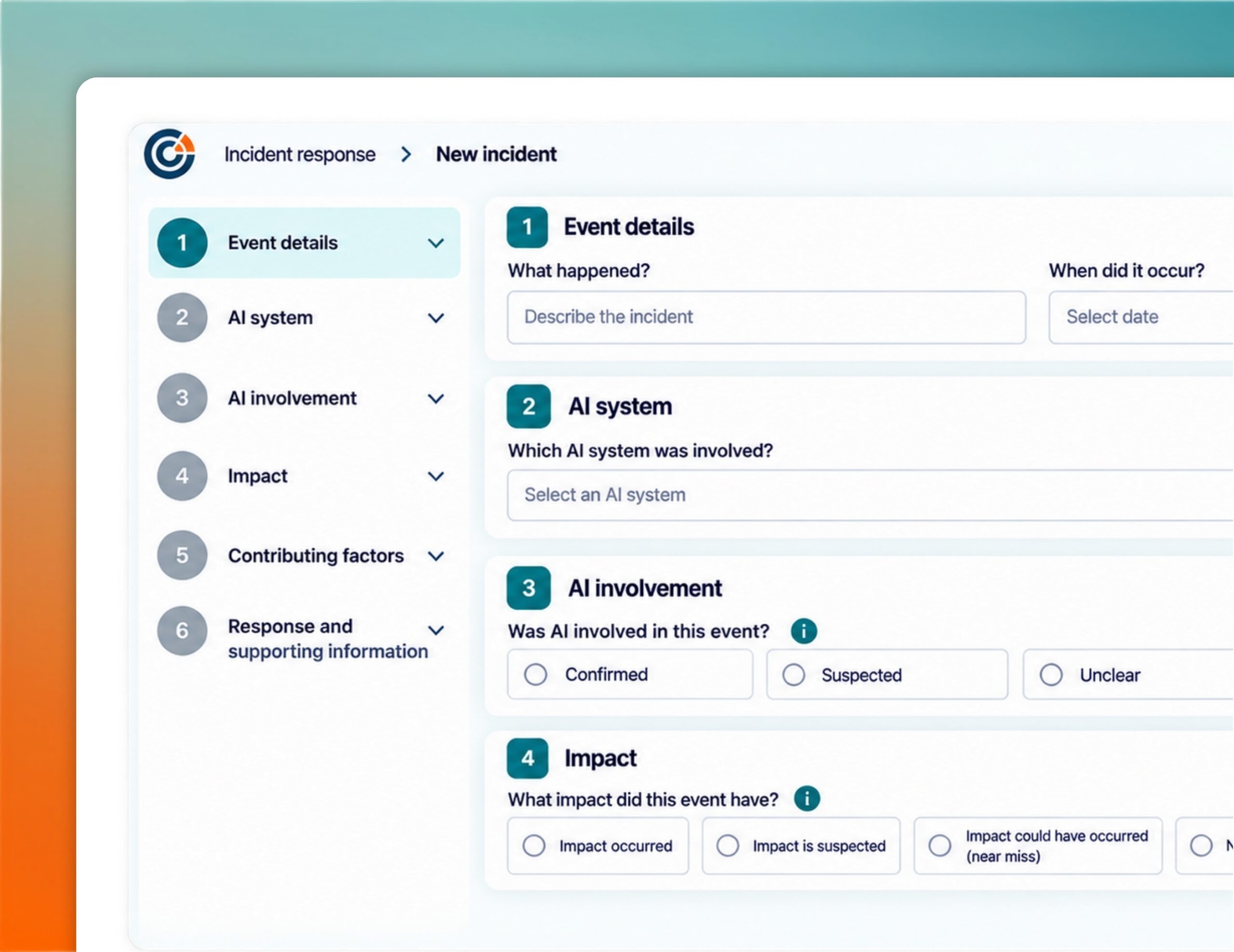
RadarFirst turns AI incident management into a structured, repeatable process that helps teams investigate what happened, assess potential impact, coordinate their response, and document every decision.

Capture the AI system involved, how it behaved, your organization’s relationship to it, resulting impacts, supporting evidence, and business context.

Evaluate potential privacy, legal, operational, financial, reputational, fairness, and safety impacts through a consistent, explainable process.

Bring legal, privacy, compliance, security, product, and business teams together around one response.
Platform Capabilities
RadarFirst helps organizations operationalize AI incident management with a structured process for investigating AI incidents, assessing AI risk, coordinating response actions, and documenting every decision.
Understand what happened.
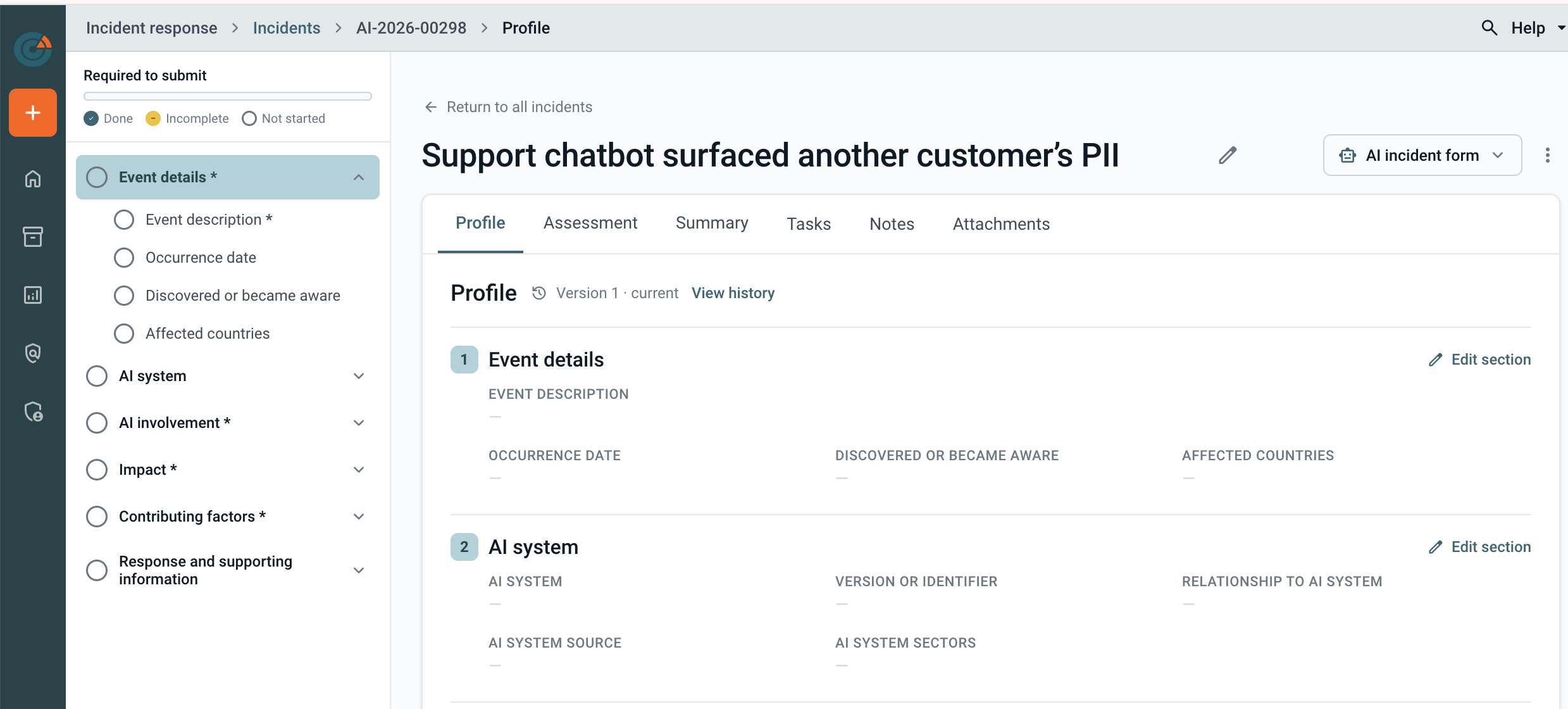
Determine what it means.
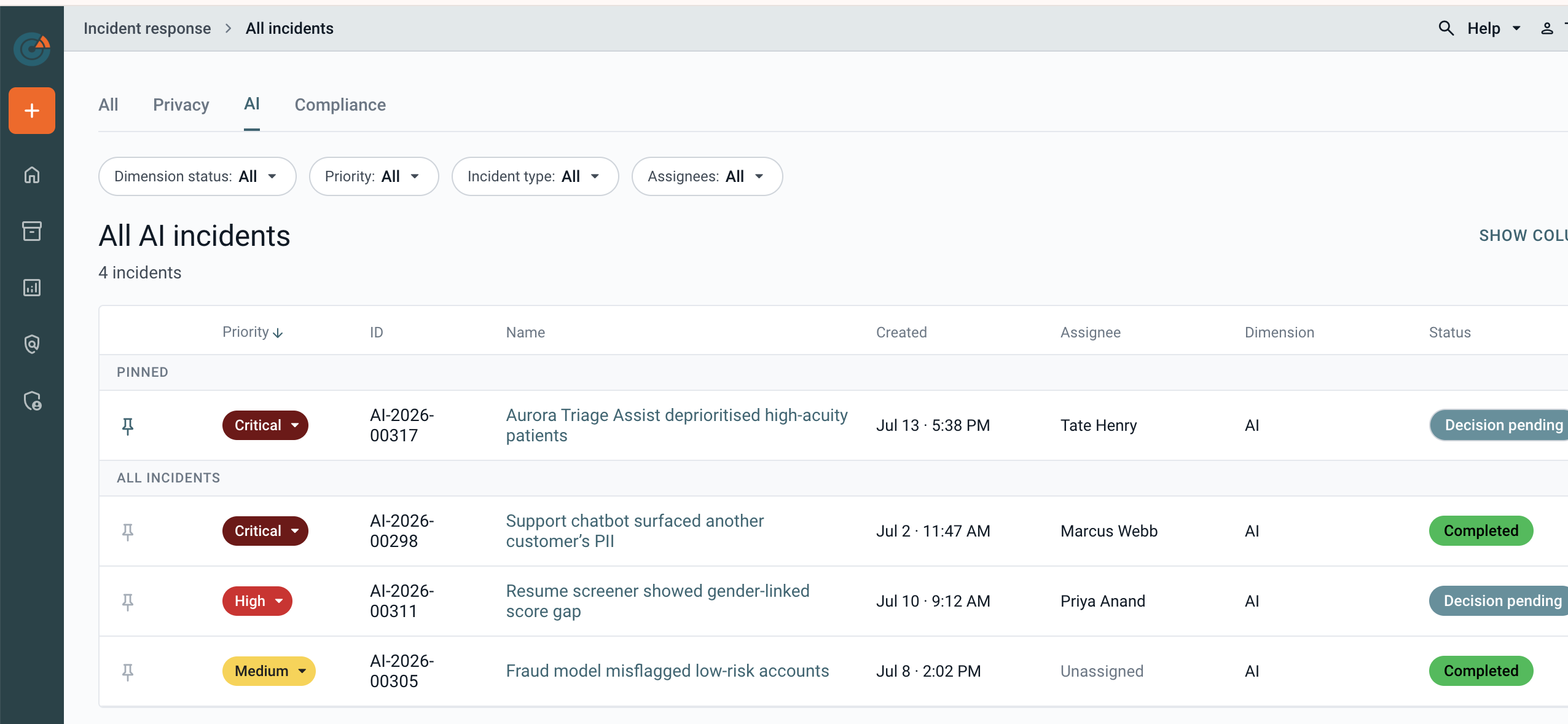
Know what to do next.
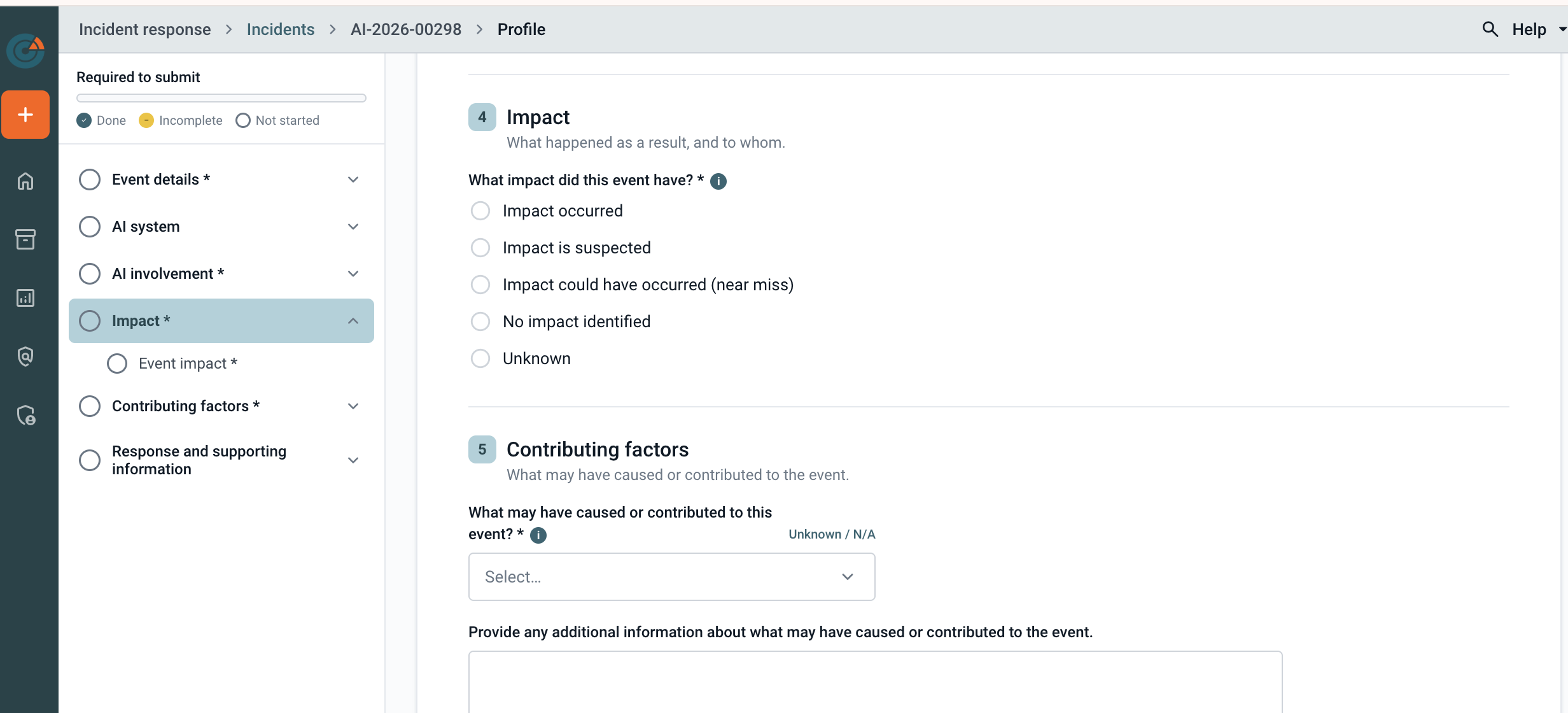
Create a defensible record.
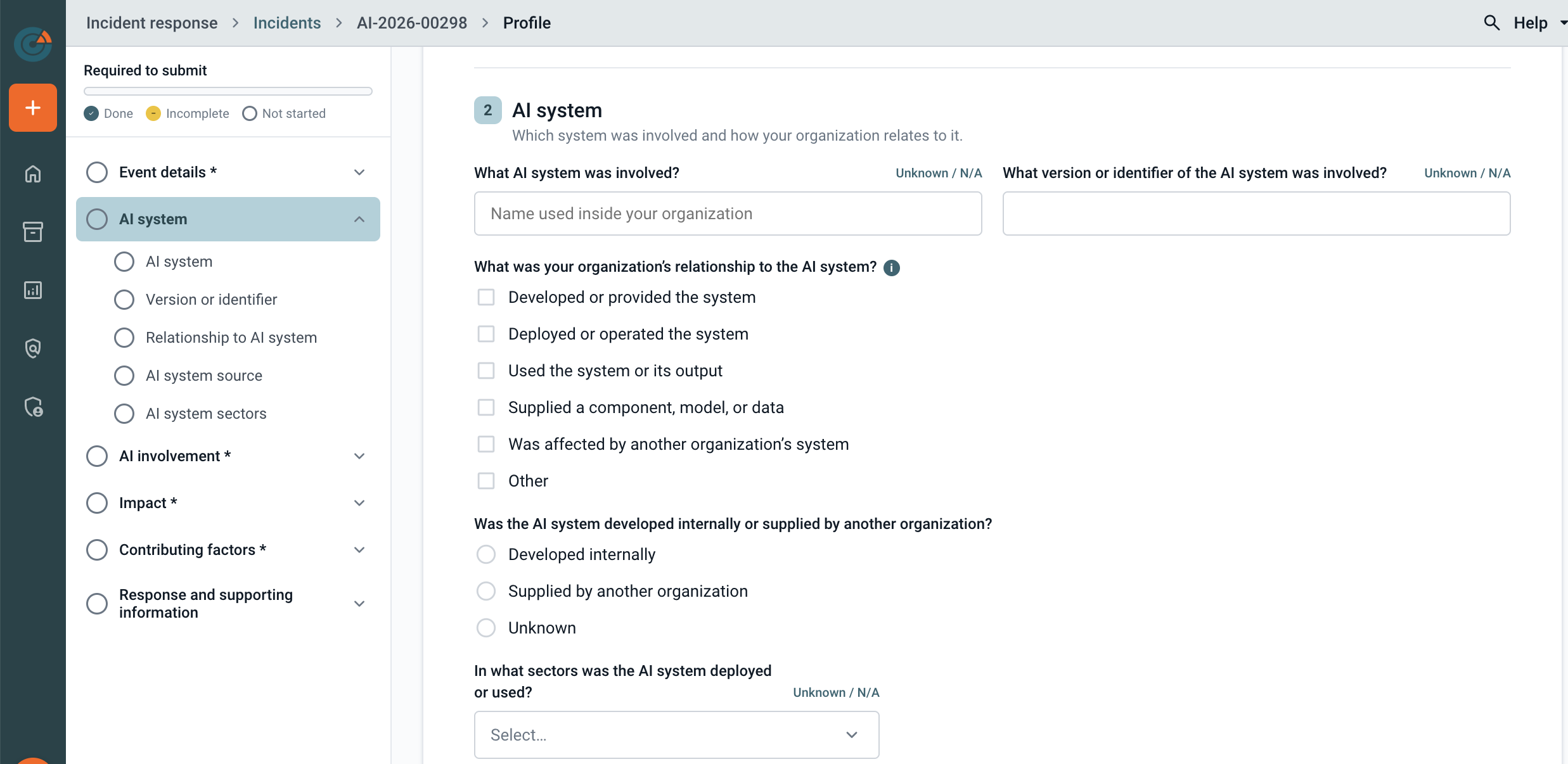
Investigate AI-generated content, recommendations, or decisions that create customer, business, or operational harm.
Respond to AI incidents involving personal information, inferred data, unauthorized processing, consent, or inappropriate disclosure.
Investigate potentially unfair, biased, or discriminatory AI behavior and outcomes.
Respond when AI use falls outside approved policies, governance requirements, or acceptable-use standards.
Respond to AI incidents that create physical, financial, safety, or operational impacts.
Features
Purpose-built capabilities to investigate AI incidents, assess impact, guide response, and maintain a complete, defensible record.
Process

Eliminate blind spots with structured incident intake.
Evaluate applicability, risk, and obligations in minutes.
Apply regulatory logic and decision-making models to reach consistent outcomes.
Maintain complete, audit-ready records without manual effort.
Why RadarFirst
RadarFirst brings years of regulatory incident management experience to a new category of AI incidents.

Manage AI incidents as a first-class category — not an extension of a privacy or generic compliance workflow.
Apply regulatory logic consistently to reach explainable, defensible decisions.

RadarFirst brings years of regulatory incident management experience to a new category of AI incidents.
Adapt as AI regulations, reporting requirements, and industry practices change.
FAQs
Explore the questions privacy, legal, compliance, security, and AI leaders ask as they prepare for, respond to, and operationalize AI incidents across the enterprise.
AI Incident Management is the process organizations use to investigate, assess, respond to, and document incidents involving AI systems or their outputs.
It creates a consistent operational response when AI causes potential harm, violates policies, exposes sensitive information, or requires investigation.
An AI incident is an event where an AI system or its output causes—or may cause—harm, risk, a policy concern, or a need for investigation or response.
Examples include harmful outputs, bias, hallucinations, privacy concerns, unauthorized AI use, safety issues, policy violations, and security events.
AI governance manages AI risk before an incident occurs. AI Incident Management manages the operational response when one does.
AI governance focuses on inventory, risk classification, policies, controls, and oversight. AIM focuses on investigation, assessment, guidance, response, and documentation.
AI incidents introduce context traditional incident processes may not capture, including the AI system involved, its behavior, the organization’s relationship to it, resulting harms, and AI-specific regulatory considerations.
An AI incident may also overlap with a privacy or cybersecurity incident.
As AI adoption grows, so does the number and variety of incidents organizations need to investigate.
Most organizations still rely on processes built for privacy, cybersecurity, or general compliance. AIM provides a repeatable process built for the distinct characteristics of AI incidents. This directly reflects the customer challenge identified in the GTM talk track.
Generative AI can help analyze information, but its outputs can vary. RadarFirst’s patented Legal Engine applies deterministic regulatory logic consistently to support explainable, defensible incident decisions.
No. People remain accountable for decisions. RadarFirst’s patented Legal Engine applies regulatory logic to provide consistent, explainable assessment and guidance.
AI incident management can involve privacy, legal, compliance, security, product, AI governance, and business teams.
RadarFirst brings those teams together around one consistent incident process and system of record.
Featured Resource
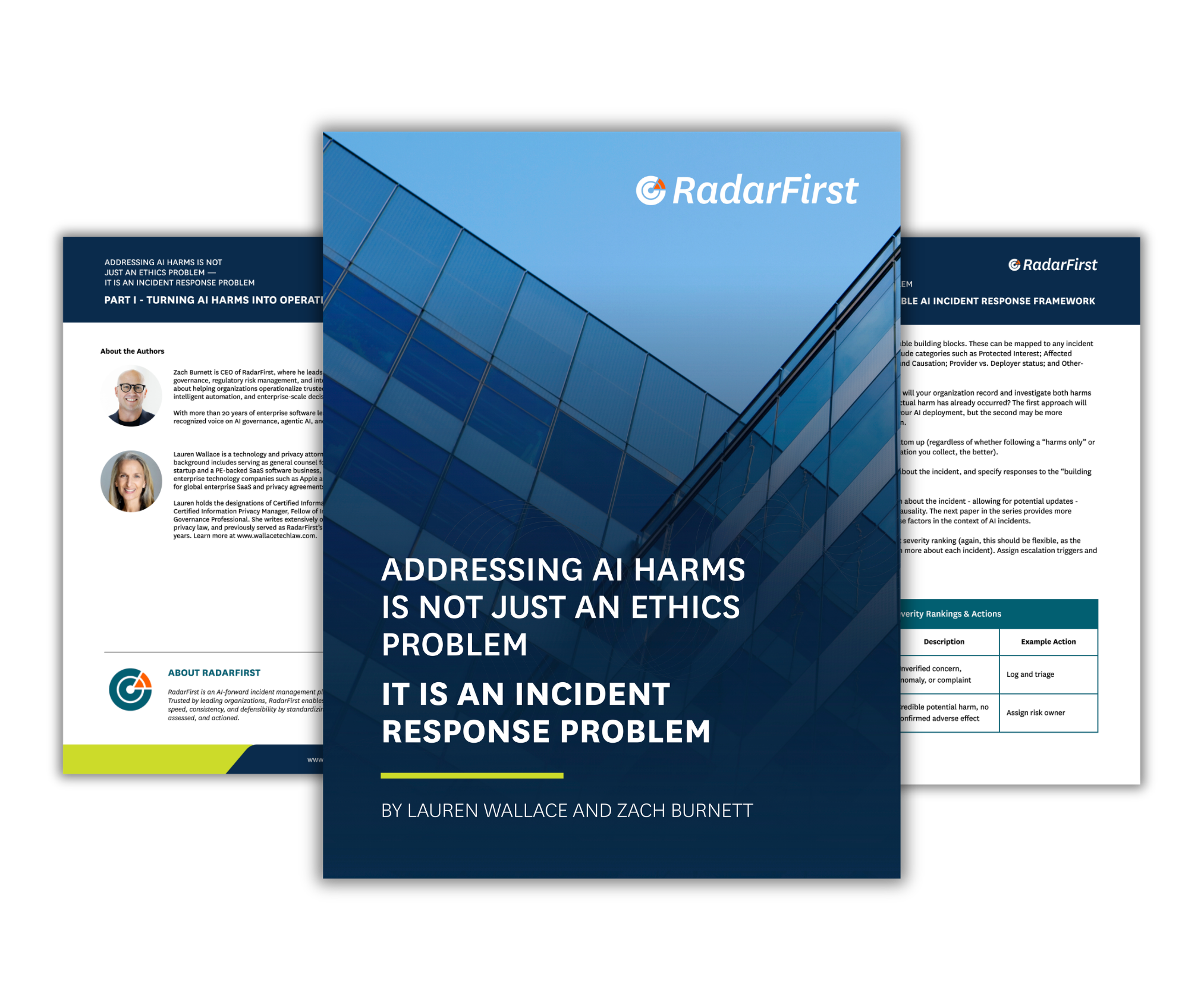
This three-part white paper series examines AI harms through an operational incident-response lens.
Each paper provides expert insights on how organizations define AI incidents, build a structured and defensible response framework, and make critical decisions about causality, severity, escalation, and reporting.

Trusted by leading organizations, RadarFirst enables teams to manage incidents with speed, consistency, and defensibility by standardizing how incidents are captured, assessed, and actioned.