
What an AI Vendor Evaluation Taught Us About AI Governance
Jump to Section
AI vendor evaluations often start with the product demo. The features look useful. The workflow feels familiar. The platform integrates with systems teams already use. On the surface, the decision can seem straightforward.
But a strong demo does not answer the most important governance question: can this AI system be used in a way that meets your organization’s standards?
We recently evaluated two AI vendors with similar functionality. Both could have helped our marketing team improve productivity. The difference was not what the tools could do. It was how confidently we could govern their use.
By assessing each vendor against our internal AI governance framework, we saw what a demo alone could not show: differences in data handling, transparency, administrative control, documentation, and policy alignment. That review changed the decision.
The lesson was simple: the best AI tool is not always the one with the strongest feature set. It is the one your organization can approve, govern, and defend.
Why AI Vendor Evaluation Needs More Than a Product Demo
Like many organizations, we have been evaluating AI tools that could help teams improve productivity without introducing unmanaged risk. Marketing was one of the first areas we reviewed, where AI writing assistants, campaign optimization tools, and automation platforms often appear similar during the buying process.
Recently, we narrowed our search to two vendors.
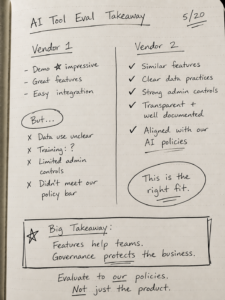
The first vendor made a strong impression. The demo was polished, the features were useful, and the platform integrated with systems we already used. Based on functionality alone, it looked like the clear choice. If the evaluation had stopped there, we likely would have moved forward. But AI adoption cannot be based on product capability alone. Before introducing a new AI system into the business, we assessed the tool against our internal AI governance standards.
What Our AI Governance Assessment Revealed
This was not simply a vendor questionnaire or a security review. It was a structured AI governance assessment designed to determine whether the tool met the standards every AI system must satisfy before business use.
That review included questions a product demo rarely answers clearly:
- How does the vendor handle customer data?
- Can submitted information be used to train future models?
- What administrative controls are available?
- Can AI features be configured, limited, or disabled?
- Is there enough documentation to explain how the system is governed?
- Would we be able to justify this decision to leadership, customers, auditors, or regulators?
As we worked through the assessment, the picture changed.
The tool itself was not inherently risky, but the governance evidence was incomplete. Some answers were vague. Important details about data handling were difficult to find. Documentation around responsible AI practices was limited, and several questions required follow-up conversations instead of being clearly addressed upfront.
No single gap would have automatically disqualified the vendor. Together, though, they showed that the platform did not meet several criteria we had established for approving AI systems.
The best AI tool is not the one with the most features. It is the one that meets your organization’s governance standards.
Why Similar AI Tools Can Carry Different Governance Outcomes
So we looked at another vendor.
Interestingly, the functionality was almost identical. Both platforms could have helped our marketing team save time and produce better work. The difference was not in what the AI could do. It was in how confidently we could govern its use.
The second vendor was transparent about its AI practices. It clearly documented how data was handled, what administrative controls were available, how customers could manage AI features, and what commitments the company had made around responsible AI.
When we evaluated the second vendor against the same governance framework, it consistently met our standards across those areas. That experience reinforced something we have seen repeatedly: choosing an AI tool should not come down to features alone.
What Should an AI Vendor Evaluation Include?
An AI vendor evaluation should assess more than functionality, cost, and ease of use. Organizations should review whether the tool aligns with internal policies for responsible data handling, transparency, oversight, and accountability.
Consistent AI Governance Starts With Internal Policy Alignment
Most organizations already have policies that guide how they manage privacy, security, compliance, vendor risk, and ethics. AI should not exist outside those expectations. It should be evaluated against them.
The challenge is that many organizations do not have a consistent way to evaluate AI systems before adoption.
One team may choose an AI tool because it improves productivity. Another may approve a platform because it is cost-effective. A third may prioritize usability or speed of implementation. Each team may be making a reasonable decision, but if they are using different criteria, governance becomes fragmented.
That inconsistency creates avoidable risk. It also makes decisions harder to defend later. Internal AI policies are only half the equation. Organizations also need a repeatable process for assessing each proposed AI system against those policies before implementation. That process helps teams identify gaps early, compare vendors consistently, and document why a tool was approved, rejected, or approved with conditions.
Consistent AI governance means every new AI system is evaluated against the same standards, not individual opinions.
The Right AI Tool Is the One You Can Govern
Regulations provide the baseline. Your organization’s AI governance policies determine whether an AI system is truly ready for use. With RadarFirst AI Risk™, you can go beyond regulatory requirements by assessing AI systems against your own AI policies. Upload internal governance policies, automatically evaluate policy alignment, and manage results with a consistent, auditable workflow.
Upload your organization’s AI policies, assess AI systems against your own governance standards, track policy alignment separately from regulatory risk, and maintain a consistent, auditable review process.
Related Posts
Insights on Privacy, AI Risk, and Compliance

Let’s Get Started
Trusted by leading organizations, RadarFirst enables teams to manage incidents with speed, consistency, and defensibility by standardizing how incidents are captured, assessed, and actioned.
