
Privacy Incident Response Checklist: From Intake to Notification
Jump to Section
A privacy incident response checklist helps teams move from uncertainty to a defensible decision. When a suspected incident is reported, the organization needs a consistent way to capture the facts, assess risk, apply the right regulatory requirements, determine whether notification is required, and document the rationale behind every action.
That structure matters because privacy incidents rarely arrive neatly packaged. A report may start as a misdirected email, a lost device, a security alert, a vendor escalation, or a brief message that “something happened.” Early facts are often incomplete, but response teams still need to preserve evidence, assign ownership, contain exposure, and keep deadlines from slipping.
This checklist outlines a practical privacy incident response process from intake to notification. It is not legal advice and does not assume a single operating model. Organizations may rely on internal teams, outside counsel, regulatory research, purpose-built decisioning technology, or a hybrid approach. The goal is the same: reach timely, consistent, explainable, and well-documented outcomes.
What Is a Privacy Incident Response Checklist?
A privacy incident response checklist is a structured workflow that helps an organization capture a suspected privacy event, assess the facts, determine whether legal or contractual notification obligations apply, document the rationale, and complete required notices within applicable deadlines. Not every privacy incident is a legally defined breach, and not every incident requires notification. The purpose of the checklist is to make that determination systematically based on complete facts and applicable requirements.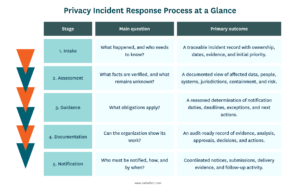
Step 1: Capture the Incident
Through Structured Intake Effective response starts with an accessible, structured intake. Employees, vendors, and partners should know where to report a suspected incident, what information to provide, and why speed matters. If reporting is difficult or overly technical, people may delay escalation or omit important details.
A mature program can accept reports through several channels, including web forms, email, service-management tools, APIs, security platforms, hotlines, and vendor escalation processes. Regardless of the source, reports should flow into one consistent process and create a traceable incident record.
Intake Checklist
- Provide a clearly communicated reporting channel.
- Create an incident record immediately, even when facts are incomplete.
- Record occurrence, discovery, and reporting dates separately.
- Capture who reported the incident and which teams, vendors, systems, or third parties are involved.
- Document what happened, what information may be involved, whose information may be affected, and which jurisdictions may apply.
- Preserve available evidence, including emails, logs, screenshots, files, or vendor communications.
- Assign an owner and initial priority. Escalate urgent containment needs without waiting for the full legal assessment.
Maturity indicator: The organization can receive incidents from multiple sources without creating multiple, disconnected versions of the truth.
Step 2: Assess the Facts, Scope, and Risk
The first report is rarely enough to determine whether notification is required. Assessment is the structured investigation used to fill gaps, validate assumptions, define the scope, and evaluate the incident under applicable privacy requirements.
A defensible assessment should answer:
- What data was involved, including sensitivity, format, and protection status?
- What happened to the data: access, acquisition, use, disclosure, loss, alteration, or confirmed exfiltration?
- Who received or may have received it?
- How many people are affected?
- Which jurisdictions, regulatory frameworks, contracts, or internal policies apply?
- What was the intent and cause? Was the event contained, and did mitigation reduce exposure?
- What harm is reasonably possible?
Different laws apply different definitions, thresholds, exceptions, and risk factors. For example, the HIPAA Breach Notification Rule identifies factors such as the nature and extent of the information, the unauthorized recipient, whether the information was actually acquired or viewed, and the extent of mitigation. That framework should not be applied universally, but it illustrates why assessment must evaluate context rather than rely on incident labels alone.
Assessment Checklist
- Confirm the data elements and protection status.
- Determine whether data was accessed, acquired, retained, or further disclosed.
- Validate affected individuals, locations, and jurisdictions.
- Document containment and mitigation measures.
- Identify relevant sectoral, state, national, international, and contractual requirements.
- Record facts separately from assumptions and unresolved questions.
- Set follow-up owners and deadlines for missing information.
Maturity indicator: Two qualified reviewers evaluating the same verified facts should be able to understand how the organization reached the same conclusion.
Step 3: Apply Regulatory Guidance and Decisioning
Once the facts are sufficiently developed, the organization must determine what legal, regulatory, contractual, and internal requirements apply. This is where teams decide whether the incident meets relevant definitions, whether exceptions or safe harbors apply, who must be notified, what deadlines govern, and what other actions are required.
The guidance model may vary. Some organizations rely on internal legal and privacy teams. Others involve outside counsel for complex, high-risk, privileged, or novel matters. Some use regulatory content, decision trees, rules engines, or legal decisioning technology to standardize how incident facts are evaluated. Many use a hybrid model.
The operating model matters less than the discipline behind it. Regulatory logic should be current. Similar facts should be evaluated consistently. Human judgment should remain accountable. The organization should be able to explain which facts and requirements drove the final decision.
RadarFirst supports this stage by helping privacy teams apply maintained regulatory logic to incident facts, standardize decisioning, and preserve the rationale behind notification and non-notification outcomes.
Guidance Checklist
- Identify every potentially applicable jurisdiction and regulatory framework.
- Apply the correct version of the law based on the relevant dates.
- Evaluate definitions, thresholds, exceptions, safe harbors, and risk standards.
- Determine whether individuals, regulators, law enforcement, customers, business partners, insurers, or other parties must be notified.
- Calculate deadlines from the legally relevant trigger.
- Record the legal and factual rationale for notification and non-notification decisions.
- Route high-risk, ambiguous, or novel matters for appropriate legal review.
Maturity indicator: The organization can explain not only what it decided, but which facts and requirements drove the decision.
Step 4: Document the Rationale as the Work Happens
Documentation should run through the entire incident lifecycle, not wait until the end. A complete record helps teams coordinate in real time and later demonstrate how they acted if the matter is reviewed by leadership, auditors, regulators, customers, or courts.
Documentation is especially important when the organization concludes that notification is not required. A mature program preserves the analysis either way.
Documentation Checklist
- Maintain one authoritative incident record.
- Preserve the original report, material updates, evidence, source of each material fact, and key dates.
- Track people involved, tasks assigned, approvals, and timestamps.
- Document applicable jurisdictions, laws, contractual duties, and internal policies.
- Preserve risk analysis, legal reasoning, guidance received, and final determinations.
- Keep copies of notices, recipient lists, delivery records, regulator submissions, and related communications.
- Record overrides, exceptions, changes in conclusion, and the rationale for them.
- Apply appropriate access, privilege, retention, and security controls.
Maturity indicator: Months or years later, an independent reviewer can reconstruct what happened, what the organization knew at each stage, and why it acted as it did.
Step 5: Execute Required Notifications
A notification decision begins the execution phase. The organization must turn the legal determination into accurate communications, approvals, delivery steps, and proof of completion, often across multiple jurisdictions with different recipients, content requirements, methods, and deadlines.
Depending on the incident, notices may be required to affected individuals, regulators, attorneys general, sector-specific authorities, law enforcement, media, customers, business partners, or other parties. For example, the GDPR requires supervisory authority notification within 72 hours when applicable, while other privacy rules may use different deadlines, recipients, or trigger dates.
Notification Checklist
- Confirm every required recipient and notification deadline.
- Determine required content, language, format, and delivery method.
- Coordinate legal, privacy, communications, customer support, security, and executive review.
- Verify the affected population and contact data before distribution.
- Prepare regulator forms, supporting documentation, and required certifications.
- Plan for inquiries from individuals, customers, employees, media, and regulators.
- Record approvals, submission dates, delivery evidence, returned notices, and follow-up actions.
- Continue remediation and lessons-learned work after notification is complete.
Maturity indicator: Notification is managed as a controlled workflow with clear owners and deadlines, not as a last-minute drafting exercise.
Where AI Can Support Privacy Incident Response
AI can support privacy incident response by reducing administrative effort, improving consistency, and helping teams find gaps earlier in the assessment. It can guide reporters through targeted intake questions, summarize case activity, identify missing or inconsistent facts, organize evidence, surface similar incident patterns, prioritize work, and help draft communications for human review.
AI should not replace accountable legal judgment. Privacy teams should understand what the AI capability is doing, what information it uses, where outputs are stored, and how results are reviewed. Legal conclusions, material overrides, and final notification decisions should remain subject to qualified human review.
Used well, AI helps teams collect, organize, and act on incident information faster while preserving human control over decisions that carry legal, regulatory, or customer-trust consequences.
What Mature Privacy Incident Response Looks Like
A mature privacy incident response program is not defined by whether the process is manual, automated, or technology-assisted. It is defined by whether the organization can respond reliably under pressure and show the work behind each decision.
In a mature program, people know how to report suspected incidents. Intake is structured but flexible. Roles, escalation paths, and decision authority are defined before an incident occurs. Assessments rely on verified facts and consistent criteria. Regulatory content and internal playbooks are kept current. Deadlines are calculated, assigned, monitored, and escalated. The full incident lifecycle is documented in one authoritative record.
Privacy incidents will never arrive with perfect information. A strong response process gives teams the structure to move from uncertainty to action: quickly, consistently, and with proof of diligence that can stand up to internal review, customer questions, audits, or regulatory scrutiny.
Looking to operationalize your program?
See how RadarFirst helps privacy teams operationalize incident intake, assessment, regulatory decisioning, documentation, and notification workflows with speed, consistency, and defensible records. Learn more
Related Posts
Insights on Privacy, AI Risk, and Compliance

Let’s Get Started
Trusted by leading organizations, RadarFirst enables teams to manage incidents with speed, consistency, and defensibility by standardizing how incidents are captured, assessed, and actioned.
