
When an Employee Asks, “What Data Do You Have About Me?”
Employee DSRs often span many systems and teams, including HR, Legal, IT, Security, and Privacy. Some records may need to be retained even when deletion is requested, and manual tracking can slow responses or increase risk. A repeatable process helps organizations stay compliant, document decisions, and build employee trust.
Jump to Section
What started as a simple HR question became a reminder that employee privacy deserves the same operational rigor as customer privacy.
When most people think about data subject requests, they picture customers exercising privacy rights under laws such as the GDPR, CCPA/CPRA, or other regional privacy regulations.
But one Tuesday morning, the request came from inside the organization.
“I’d like a copy of all the personal data the company has about me.”
At first, the request seemed straightforward. HR acknowledged it and expected to pull the necessary records from the HR system.
It was not that simple.
When an Employee Submits a Data Subject Request
An employee data subject request is a privacy request from a current or former employee asking to access, correct, delete, or receive a copy of personal data an employer holds about them.
The specific rights, deadlines, and exceptions depend on the applicable laws. But the operational challenge is often the same: employee data is distributed across many systems, teams, and business processes.
A complete response may require more than HR records. It may also require input from Legal, IT, Security, Privacy, and other teams that manage systems where employee information is created, stored, reviewed, or retained.
Why Employee Data Is Hard to Find
The employee’s information was not confined to one system.
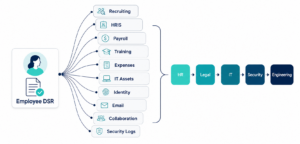
It appeared in recruiting platforms from before they were hired. It continued through onboarding, performance management, training systems, expense tools, IT asset records, identity providers, email archives, collaboration platforms, and security logs.
Suddenly, one request had become a cross-functional effort.
HR needed Legal.
Legal needed IT.
IT needed Security.
Security needed Engineering.
And each team had a different view of what might count as personal data.
Employee Data Spans the Full Employment Lifecycle
Employee data begins before someone’s first day.
Before hiring, organizations may collect resumes, interview notes, background check information, recruiter communications, assessment results, and offer documentation.
After hiring, new categories of employee data appear across the organization, including:
- Payroll and tax records
- Benefits information
- Training history
- Performance reviews
- Device assignments
- Badge access logs
- Security monitoring data
- Internal support tickets
- Collaboration records
- IT account and identity data
- Some of this information is easy to locate.
Some is not.
Some records may need to be retained for legal, tax, regulatory, employment, or litigation-related reasons, even when an employee asks for deletion.
And some data may exist in systems no one immediately remembers during the first round of review.
This is why employee DSRs often become discovery exercises instead of simple exports.
Why Employee DSRs Require Cross-Functional Coordination
Employee privacy requests are not owned by a single department.
HR understands employment records and personnel processes.
IT knows where user accounts, devices, applications, and system access information may be stored.
Security evaluates logs, monitoring data, access records, and incident-related information.
Legal interprets applicable rights, exemptions, deadlines, and retention obligations.
Privacy coordinates the process, tracks completion, and helps ensure the response is consistent and documented.
Without a defined workflow, requests can bounce between teams. That creates delays, increases the risk of incomplete responses, and makes it harder to prove how the organization reached its decisions.
The Risk of Managing Employee DSRs Manually
Manual coordination can work when requests are rare and systems are simple.
It becomes harder as the organization grows.
Spreadsheets and email threads make it difficult to answer basic operational questions:
- Has every relevant system been reviewed?
- Which teams have responded?
- Which systems still need follow-up?
- What information is exempt from disclosure?
- Which records must be retained?
- What decisions have been documented?
- How close is the organization to the response deadline?
- Every new SaaS application, acquisition, internal tool, or business process can create another location where employee data may reside.
The challenge is not only finding the data. It is showing that the organization searched the right places, involved the right people, applied the right exceptions, and documented the outcome.
What a Repeatable Employee DSR Process Should Include
Organizations that handle employee privacy requests well do not rely on memory, one-off effort, or a single person who knows where everything lives.
They build a repeatable process that includes:
- A clear intake path for employee privacy requests
- An inventory of systems that may contain employee data
- Defined responsibilities across HR, Legal, IT, Security, and Privacy
- Standard steps for searching, reviewing, and validating records
- Legal review for exemptions, retention obligations, and third-party information
- Documented approval workflows
- Deadline tracking and escalation paths
- Consistent communication with the employee
- Audit trails showing how each request was fulfilled
The goal is not only regulatory compliance. It is also transparency, consistency, and proof of diligence.
A single employee DSR can involve HR records, IT systems, security logs, legal review, and privacy oversight. Organizations respond best when they have a repeatable process that coordinates teams, tracks decisions, and documents every step.
Employee Privacy Is an Operational Trust Issue
In this case, the employee received a complete response on time.
Not because one person knew where every piece of information lived.
Because the organization had a process for coordinating people, systems, decisions, and deadlines.
As employee privacy rights continue to evolve, these requests are becoming more common. Organizations that prepare now will spend less time scrambling later and more time delivering consistent, trustworthy responses.
Employees expect their personal information to be handled with the same care organizations promise to customers.
Increasingly, regulators expect that too.
Frequenly Asked Questions
Can employees submit data subject requests?
Yes. In many jurisdictions, employees have privacy rights similar to those available to customers or consumers. Depending on the applicable law, employees may have the right to access, correct, delete, or receive a copy of certain personal data an employer holds about them.
The specific rights and exceptions vary by jurisdiction.
What information is included in an employee data subject request?
An employee DSR can cover a wide range of personal information, including:
- Employment records
- Recruiting and onboarding documents
- Performance reviews
- Training history
- Payroll and benefits information
- IT account information
- Security and access logs
- Help desk tickets
- Communications that contain personal information
Not every record must be disclosed. Some information may be exempt because of legal obligations, retention requirements, the rights of other individuals, privilege, confidentiality, or employment law considerations.
Can an employee request that all of their data be deleted?
In some jurisdictions, employees may have a right to request deletion of certain personal data. But employers often must retain specific records for legal, tax, payroll, regulatory, employment, or litigation-related reasons.
When data cannot be deleted, the organization should clearly explain why it is being retained, document the decision, and apply the appropriate retention period.
How long does an employer have to respond to a data subject request?
Response deadlines depend on the applicable privacy law.
For example, the GDPR generally requires a response within one month, with possible extensions in certain circumstances. Other privacy laws may use different timelines. Organizations should confirm the requirements that apply based on jurisdiction, employee location, and business context.
Why are employee data subject requests difficult to manage?
Employee data is rarely stored in one place. A single request may require information from HR systems, payroll platforms, identity management tools, collaboration software, security systems, recruiting platforms, and other business applications.
Without a standardized process, employee DSRs can become manual, time-consuming, and difficult to track.
What is the best way to prepare for employee privacy requests?
Organizations are best positioned when they treat employee privacy as an operational process rather than a one-time task.
That means maintaining an inventory of systems that contain employee data, defining responsibilities across HR, Legal, IT, Security, and Privacy, documenting workflows, tracking deadlines, and maintaining an audit trail of how each request is fulfilled.
A repeatable process helps organizations meet privacy obligations while demonstrating transparency and accountability to employees.
Related Posts
Insights on Privacy, AI Risk, and Compliance

Let’s Get Started
Trusted by leading organizations, RadarFirst enables teams to manage incidents with speed, consistency, and defensibility by standardizing how incidents are captured, assessed, and actioned.
