

Key Trends in AI Governance: Insights from IAPP
Want to share this?


At this year’s IAPP Global Privacy Summit, conversations across the convention floor reflected a clear shift in how organizations are thinking about AI, privacy, and regulation. From formal sessions to informal discussions, one theme stood out. AI is no longer theoretical. It is actively reshaping the governance landscape.
AI’s Expanding Influence
Chris Washington, Chief Technology Officer at RadarFirst, observed that artificial intelligence dominated nearly every conversation. Attendees consistently raised questions around where to focus their efforts. Should organizations prioritize safety, privacy, or productivity?
While productivity remains a compelling use case, the overwhelming sentiment leaned in a different direction. Most professionals are prioritizing privacy and safety, signaling a meaningful shift in how organizations are evaluating AI risk and opportunity.
A More Complex AI Landscape
Chris also highlighted the growing adoption of agentic AI architectures. Unlike traditional models, these systems rely on multiple interacting agents, introducing new layers of complexity.
This evolution significantly raises the stakes for governance. As AI systems become more dynamic and interconnected, ensuring privacy and safety becomes more challenging. Organizations are now facing a new class of risks that require more sophisticated oversight and control.
From Discussion to Action
Alex Layng, VP of Product at RadarFirst, emphasized that the conversation has moved beyond the question of whether AI governance is necessary. That question has already been answered.
The real focus now is on execution. Organizations are actively preparing for regulatory changes that feel inevitable, even if the exact timing remains unclear. There is a strong sense of urgency across the industry, with teams recognizing that waiting is no longer a viable strategy.
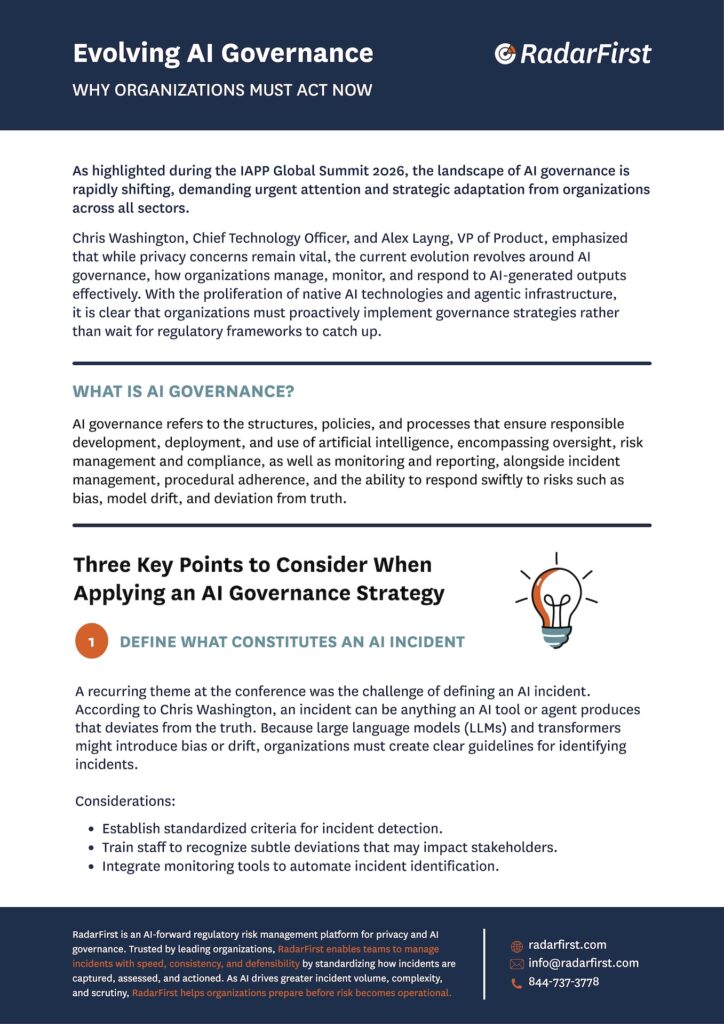
The Bottom Line: Readiness Is Critical
The takeaway from IAPP is clear. The industry is at an inflection point.
As AI systems grow more complex and regulations continue to evolve, organizations must accelerate their governance approach. Preparation is no longer optional. It is a near-term priority.
Those who invest now in building strong AI governance frameworks will be far better positioned to navigate what comes next.