

Privacy and Compliance in Finance: A Modern Framework
Want to share this?


A New Era of Accountability
When something goes wrong with customer data, the biggest problem isn’t always the breach itself. It’s the scramble that follows. Teams dig through spreadsheets, emails, and chat threads trying to piece together what happened, who needs to act, and what to report.
For banks, investment firms, and credit unions, privacy and compliance response isn’t just about checking a regulatory box, it’s about running a tighter, more resilient operation. The institutions that get it right treat compliance as part of how they do business every day, not just when there’s a crisis.
That’s where automation changes everything. Automating intake, assessment, and workflows eliminates hours of manual work, reduces errors, and clears the bottlenecks that slow teams down when time and accuracy matter most. With the right systems in place, compliance becomes less about paperwork and more about performance. A bank’s ability to respond to security incidents in a planned and coordinated fashion is important to the success of its information-security program.” – Incident Response Programs: Don’t Get Caught Without One (The Federal Deposit Insurance Corporation)
The Four-Phase Framework for Financial Privacy & Compliance
This framework provides a practical foundation for building a defensible, scalable, and resilient approach to privacy and compliance response across the financial sector.
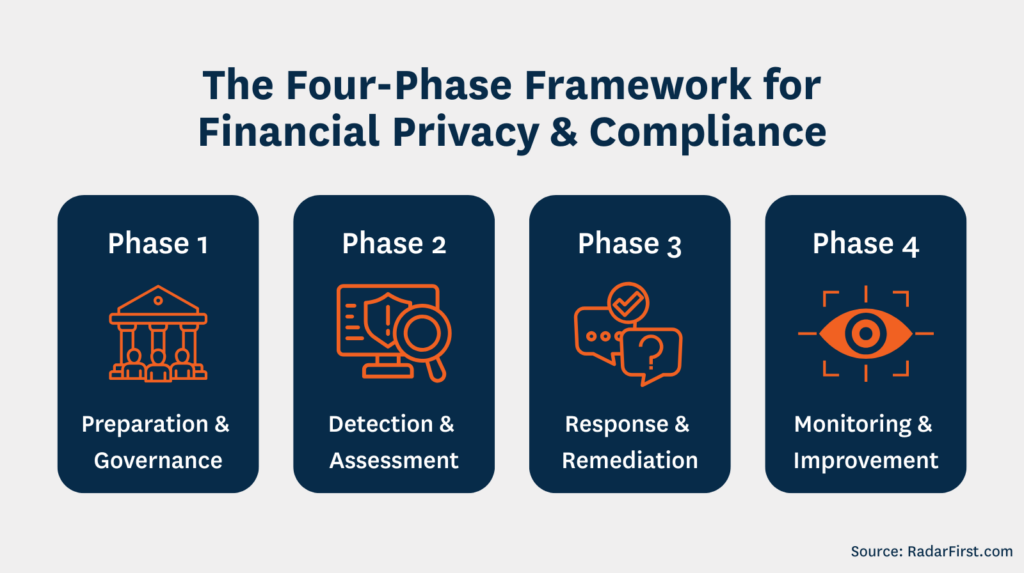
Phase 1: Preparation & Governance
Goal: Establish the foundation for privacy readiness through policy, structure, and awareness.
Key actions include:
- Define roles and responsibilities across privacy, compliance, risk, and IT teams.
- Develop a complete data inventory of what you collect, where it lives, and who accesses it.
- Map all regulatory and contractual obligations (GLBA, SEC, state privacy laws, etc.).
- Align controls with standards like NIST CSF, ISO 27001, and FFIEC guidance.
- Implement clear, approved policies for incident response, retention, and vendor oversight.
A well-defined governance structure ensures your organization doesn’t waste critical hours debating roles or approval chains when an incident strikes.
Phase 2: Detection & Assessment
Goal: Identify privacy or security incidents early, assess their impact, and determine response requirements.
Speed is essential. The faster a potential incident is identified, contained, and assessed, the lower the risk of escalation. For financial institutions, detection often starts at multiple points, including IT monitoring systems, customer complaints, employee reports, or vendor alerts.
Key actions include:
- Build a standardized intake process for employees, partners, and customers to report incidents.
- Use a scoring model to assess severity, affected data types, and potential exposure.
- Determine applicable notification requirements across states or countries.
- Escalate automatically to legal and compliance teams for review and documentation.
The objective in this phase is accuracy over panic. Quick but well-documented assessments protect your organization from both under- and over-reporting, a key regulatory expectation.
Phase 3: Response & Remediation
Goal: Contain the incident, notify affected parties, and strengthen systems to prevent recurrence.
Once an incident is confirmed, response protocols must activate immediately. This phase is about control, transparency, and accountability.
Key actions include:
- Secure affected systems and preserve forensic evidence.
- Notify regulators, customers, and partners in line with jurisdictional rules.
- Document every decision and action for audit readiness.
- Analyze root causes and update security or process controls to close gaps.
Equally important is the audit trail. This includes documentation of every decision, communication, and corrective action. Regulators increasingly demand proof that organizations acted promptly and responsibly.
Phase 4: Monitoring & Continuous Improvement
Goal: Turn privacy and compliance into a living, adaptive system that evolves with regulation and risk.
A strong framework doesn’t end when a case closes. Continuous monitoring and improvement ensure long-term resilience.
Key actions include:
- Conduct post-incident reviews to identify improvements.
- Track evolving regulations and update your response playbooks accordingly.
- Monitor metrics such as time to detect, time to decision, and notification accuracy.
- Deliver regular training to strengthen privacy awareness across teams.
Continuous improvement transforms compliance from a checkbox exercise into a competitive advantage. It’s proof that your institution values both security and trust.
From Chaos to Control
Every organization knows the feeling of managing privacy and compliance across dozens of systems, spreadsheets, and messages can feel impossible. When incidents happen, the last thing you need is to dig through old emails or Slack threads trying to find the right version of a report.
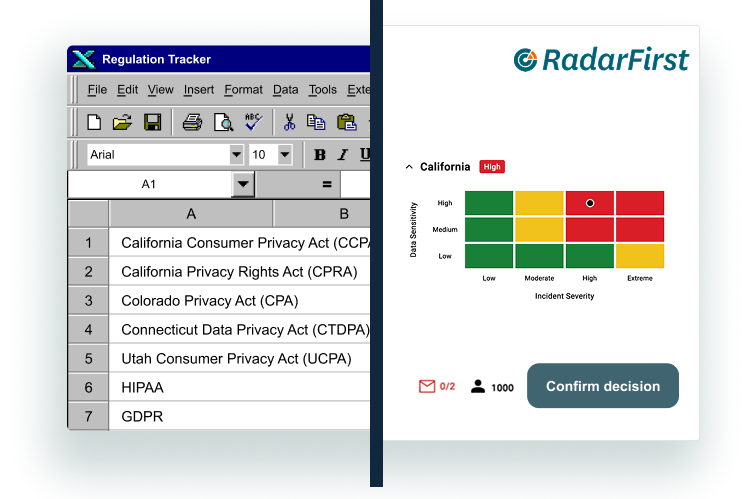
At some point, it becomes clear: you can’t manage modern privacy response with yesterday’s tools. Automation isn’t just about saving time. It’s about gaining clarity, consistency, and confidence when it matters most.
That’s where platforms like RadarFirst come in. By bringing everything starting with the intake, assessment, notifications, and documentation, into one place, teams can move faster, stay aligned, and respond with precision.
Because when regulators, customers, and partners come knocking, it’s not the size of your team that counts. It’s how ready you are to act.