

Top 10 Privacy Incident Metrics Every Healthcare Provider Should Track in 2026
Want to share this?


The Year Privacy Became a Measurable Advantage
Healthcare privacy programs have evolved far beyond checklists and compliance boxes. In 2025, the most resilient health systems treat privacy like any other strategic discipline: data-driven, measurable, and performance-optimized.
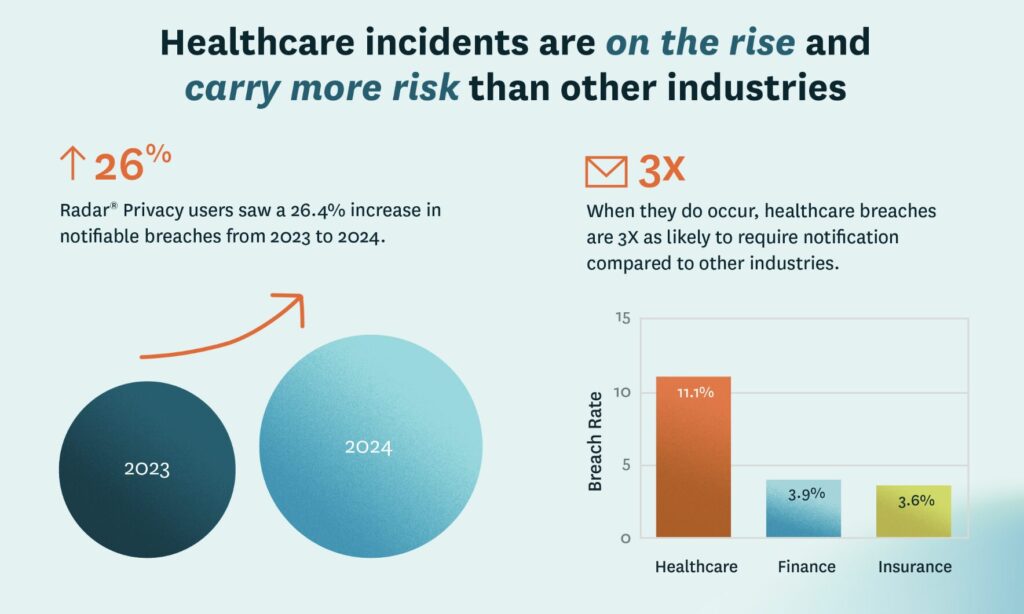
According to RadarFirst’s 2025 Healthcare Benchmarking Report, privacy incidents in healthcare rose 26.4% year over year, and the industry remains three times more likely to experience notifiable breaches compared to others. Despite that, 83.6% of healthcare breaches, among Radar First users, were reported on time under HIPAA’s 60-day rule. It’s a strong sign that our users are improving their discipline and speed.
Healthcare privacy programs have evolved far beyond checklists and compliance boxes. In 2025, the most resilient health systems treat privacy like any other strategic discipline: data-driven, measurable, and performance-optimized.
As the privacy landscape continues to shift, your ability to track, analyze, and act on the right metrics determines not just compliance, but trust.
We put together a list of 10 privacy incident metrics every health system should track in 2026, based on data from our latest benchmarking report and our work with hundreds of privacy and compliance leaders.
1. Average Time to Breach Decision
Why it matters:
HIPAA allows up to 60 days to notify affected individuals, but leading organizations make determinations in days, not weeks. Tracking this helps you measure efficiency and identify bottlenecks in your intake-to-decision workflow.
Pro tip: Use automation to reduce manual review. Radar Privacy users routinely cut decision times by up to 50%, ensuring compliance and agility.
2. Percent of Incidents Escalated to Breach Notification
Why it matters:
This metric reveals how effectively your team triages risk. According to our 2025 Benchmarking Report, healthcare organizations are reporting notifiable breaches 26.4% more frequently, signaling growing awareness and stricter internal assessments.
What to watch: A high escalation rate could indicate over-reporting (risk aversion), while a very low rate may signal under-reporting. Aim for consistency and defensibility.
3. Root Cause by Category
Why it matters:
Understanding “why” incidents occur is essential for prevention. In 2025, human error remained the leading cause of privacy incidents, outpacing technical or external factors.
Categories to monitor:
- Human error (misdirected emails, wrong attachments)
- System issues (misconfigurations, failed controls)
- Third-party incidents (vendors, business associates)
Benchmark your distribution against industry peers to target improvement.
4. Time to Notification by Incident Type
Why it matters:
Different incidents have different risk profiles. At the same time, you have to remember the clock starts ticking the same for every incident. Tracking notification timelines helps teams fine-tune playbooks for each scenario.
Our insight:
Organizations that use automated risk assessment tools are 2x as likely to report on time or early, thanks to standardized decision logic and integrated workflows.
5. Repeat Incident Rate (Per Quarter)
Why it matters:
Repetition signals process weakness. If certain departments, systems, or vendors show recurring patterns, that’s a red flag for training or technical reinforcement.
How to use it:
Correlate with training data and root cause trends to strengthen accountability and prevention programs.
6. State-Level Variance in Reporting Obligations
Why it matters:
HIPAA isn’t the whole story. Every state (and many contracts) layer additional breach requirements. Tracking incidents by jurisdiction helps compliance teams anticipate multi-state notifications.
Example:
Some states require notification within 30 days or less, which is half of HIPAA’s window. Benchmarking these differences keeps your team proactive and audit-ready.
7. Cross-Department Collaboration Time
Why it matters:
Breach decisions aren’t made in a vacuum. Measuring how long it takes for Privacy, Security, and Legal to coordinate reveals operational maturity.
Benchmark insight:
Health systems that integrate privacy and security workflows (often through tools like Radar Privacy) see reduced manual effort and cut incident response times by up to 50% compared to those using siloed systems.
8. Automation Utilization Rate
Why it matters:
Automation isn’t just an efficiency metric. It’s a compliance safeguard. It ensures consistency in risk scoring and documentation, reducing subjective errors.
How to track:
Measure what percentage of incidents are processed using automated workflows or decision support versus manual judgment. According to data from Dialog Health, healthcare organizations leveraging AI and automation tools detected and contained incidents 98 days faster than the average, saving nearly $1 million in incident response costs.
9. Audit Readiness Score
Why it matters:
Documentation completeness and consistency are the cornerstones of defensibility. This metric reflects how easily you can produce audit-ready records for regulators or internal review.
Our insight:
Teams using structured incident documentation frameworks demonstrate up to 2× faster audit response times and fewer follow-up requests.
10. Notifiable Incidents per 1,000 Patient Records
Why it matters:
This normalizes breach data for organizational size and provides a year-over-year trend indicator. In our 2025 data, healthcare averaged nearly double the notifiable rate of other industries.
Tracking this longitudinally helps privacy leaders justify investments in automation, training, and vendor management and showcase measurable ROI.
Turning Data Into Action
Collecting metrics is one thing; operationalizing them is another.
The most mature healthcare organizations are doing both: using tools like Radar Privacy to automate intake, risk assessment, and reporting while continuously improving their privacy posture through metrics that matter.
As shown in the 2025 RadarFirst Healthcare Benchmarking Report, teams that track and act on data achieve:
- 50% faster time-to-breach decision
- Stronger HIPAA and HITRUST audit readiness
- Higher on-time reporting rates (83.6%)
- Greater cross-functional alignment between privacy, compliance, and security
When your privacy program runs on data, compliance becomes predictable. This way, trust becomes measurable.
Build Your 2026 Privacy Metrics Playbook
The metrics above aren’t just numbers. They’re signals of your organization’s ability to protect patient trust and regulatory credibility in a rapidly changing world.
Ready to see how your health system stacks up?