

Why AI Incident Management Is the Next Must-Have Layer of AI Governance
Want to share this?


AI is no longer a side initiative. It is embedded in products, workflows, customer experiences, and strategic roadmaps. Enterprises are investing heavily in AI native systems and agentic tools that can reason and act autonomously. The upside is enormous.
So is the risk.
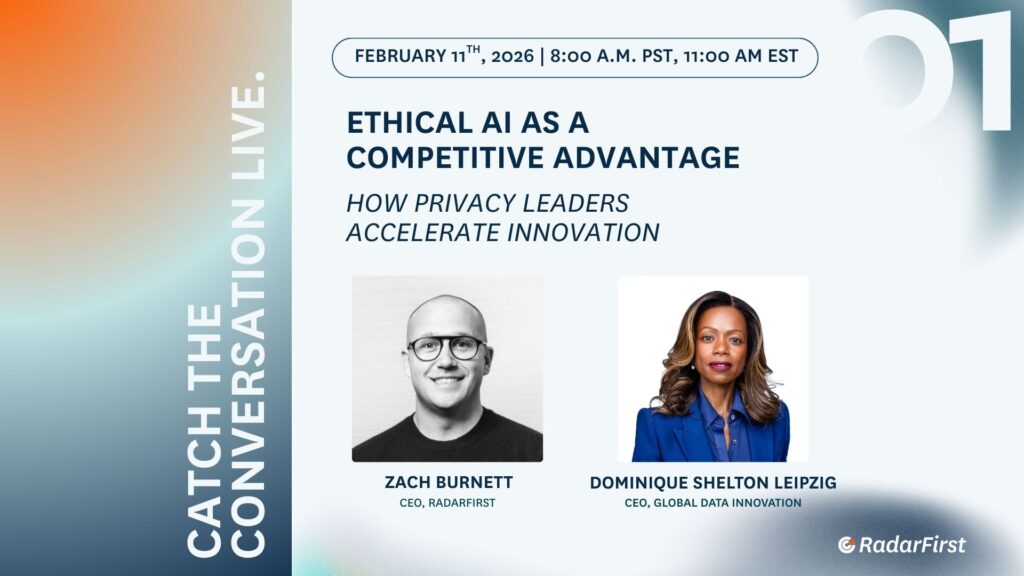
In a recent live discussion, RadarFirst CEO Zach Burnett and Global Data Innovation CEO Dominique Shelton Leipzig explored what is really happening beneath the surface of AI adoption. Their exchange revealed something important. AI governance is no longer about drafting principles. It is about operational readiness. And at the center of that readiness is AI incident management.
The Acceleration of AI, and the Exposure That Follows
Zach opened the conversation with a clear market observation. AI budgets are rising sharply, especially among large enterprises. Organizations are moving beyond experimentation into enterprise-wide deployment. Agents are no longer just answering questions. They are driving workflows.
That shift fundamentally changes the risk profile.
As Zach noted, when AI systems move from productivity enhancement to operational decision making, the margin for error narrows. A hallucination is no longer a curiosity. It can become a flawed recommendation, a regulatory issue, or a reputational event.
Dominique agreed, framing the moment through the lens of boardrooms and investor conversations. Institutional investors are no longer passively observing AI growth. They are asking direct questions about governance, oversight, and accountability. Boards are being pressed to demonstrate fluency in generative AI governance and to show which framework they use to evaluate risk.
The message from capital markets is clear. If you are deploying AI at scale, you must be able to demonstrate how you govern it.
Governance Must Be Demonstrable, Not Theoretical
Dominique emphasized that investors want oversight to be self-evident. It is no longer sufficient for boards to delegate AI oversight quietly to management. They are being asked:
- How is AI risk ranked?
- What framework is being used?
- How is management reporting structured?
- What training has the board completed?
Zach built on this point by highlighting the practical side. When questions arise on earnings calls or during proxy season, organizations need more than policy documents. They need a documented, repeatable process for identifying, escalating, and resolving risks.
This is where governance becomes operational. And where AI incident management becomes central.
Do Not Wait for Perfect Regulation
One of Dominique’s strongest insights was about timing. With more than 100 countries drafting or implementing AI-related laws, leaders often feel paralyzed by regulatory uncertainty. But waiting for final legislation before building protections is a mistake.
Common governance principles are already clear across jurisdictions. Risk ranking. Data integrity. Ongoing monitoring. Incident response. These elements are not being rolled back. Even as regulatory complexity evolves, the core operational expectations remain consistent.
Zach connected this directly to enterprise reality. Organizations cannot afford to treat governance as a future compliance exercise. AI is already deployed. Incidents are already occurring. The only viable path forward is to codify what is known today and operationalize it.
The Parallel to Privacy: A Warning and an Opportunity
Dominique drew a powerful parallel to the early days of privacy and cybersecurity. In the late 1990s and early 2000s, many boards were passive. Oversight was fragmented. Laws lagged behind technology. The result was massive economic loss from data breaches and cyber incidents.
Today, AI is at a similar inflection point.
Zach and Dominique aligned on this. The organizations that treat AI governance as a strategic operating discipline now will avoid the reactive cycle that defined the early years of privacy and cybersecurity.
The difference this time is that we can see the pattern forming in real time.
Where Governance Breaks Down: The Incident Gap
Throughout the conversation, a recurring theme emerged. Most AI governance programs are heavy on principles and committees. They are lighter on operational response.
When an AI incident occurs, many organizations struggle to answer critical questions quickly:
- What system produced the outcome?
- What data was used?
- Was a vendor involved?
- Has model drift occurred?
- Who owns escalation?
- What documentation exists?
Dominique referenced research showing that AI incidents often correlate with missing trust elements. Lack of proper risk triage. Inadequate data documentation. Gaps in monitoring and auditing. Weak escalation pathways.
Zach tied this back to a broader industry framing. Analysts are increasingly defining AI governance in three motions. Inventory and data lineage. Risk and governance workflows. Monitoring and observability.
AI incident management sits at the intersection of all three.
Without inventory, you cannot investigate. Without governance workflows, you cannot triage. Without monitoring, you cannot detect issues early. Incident management is where these pillars converge.
Vendor Risk: The Silent Multiplier
Another area where their perspectives aligned was third-party risk. Many enterprises rely on vendors whose tools embed AI. Often, AI capabilities are not fully understood at the time of purchase.
Dominique stressed that clarity is the best antidote to reputational embarrassment. Vendor vetting must include AI-specific questions. How is the model trained? What data is used? What testing is performed? What monitoring is in place? How are incidents escalated?
Zach added that governance fails when the process depends on memory or isolated knowledge within a single division. Organizations need centralized dashboards, structured workflows, and documented checkpoints.
In other words, AI vendor risk is not solely a procurement issue. It is an AI incident management issue.
The Category Shift: From AI Governance to AI Incident Management
As the discussion progressed, a subtle but important conclusion emerged. AI governance is becoming a defined category. But its most urgent and measurable subcategory is AI incident management.
Boards want defensibility. Investors want transparency. Regulators want accountability. Customers want trust.
All of these demands converge into a single operational capability. The ability to identify, triage, document, and resolve AI-related incidents with speed and clarity.
Zach made it clear that RadarFirst has invested deeply in understanding the technical impact of AI innovation and in codifying global legal requirements into practical processes. The objective is not abstract compliance. It helps organizations understand their risks and serve their constituencies responsibly.
Dominique’s trust framework complements this by identifying the governance elements most correlated with AI success and the absence of incidents. Risk ranking. Proper training data documentation. Continuous testing and monitoring. Clear escalation mechanisms.
Together, these insights form a coherent model. Governance principles must translate into incident-ready operations.
The Competitive Advantage of Being Incident Ready
The conversation began with the idea of ethical AI as a competitive advantage. It ended with a clearer articulation of how that advantage is realized.
Organizations that build strong AI incident management capabilities can:
- Deploy AI faster with defined guardrails
- Detect drift and anomalies earlier
- Respond decisively when issues arise
- Demonstrate credible oversight to investors
- Reduce litigation and regulatory exposure
- Strengthen brand trust
Ethical AI is not simply about good intentions. It is about disciplined execution under pressure.
Governance Will Be Measured by Response
AI governance is maturing rapidly. But its credibility will not be measured by policy binders or committee structures. It will be measured by how organizations respond when AI systems fail, drift, or cause harm.
The collaborative insight from this discussion is clear. Boards must be fluent. Frameworks must be operational. Organizations must not wait for perfect legislation. And incident response must be embedded at the core of governance architecture.
AI incident management is not an afterthought. It is the operational proof that governance works.
The organizations that recognize this now will not just comply with the future of AI oversight. They will define it.