

The EU AI Act: A Comprehensive Overview for Risk Management
Automate AI risk assessment with Radar® Compliance.
The EU AI Act is the European Union’s flagship regulation for artificial intelligence. This regulation affects organizations that develop or use AI, both within and outside the EU. The EU AI Act adopts a risk-based approach, establishing requirements and expectations for specific uses of AI to protect privacy rights and promote the EU as a leader in AI development and governance.
The EU AI Act affects organizations that develop, distribute, and deploy AI systems within the European Union (EU) market. This includes:
- Providers: Those who develop or have an AI system or model developed and place it on the European Union (EU) market.
- Deployers: Users of AI systems.
- Importers: Those who place an AI system on the EU market.
- Distributors: Anyone who makes an AI system available on the EU market (that is not a provider or an importer).
Any organization placing its product or model on the EU market falls within the scope of this regulation, regardless of its location. This is referred to as “extraterritorial influence.”
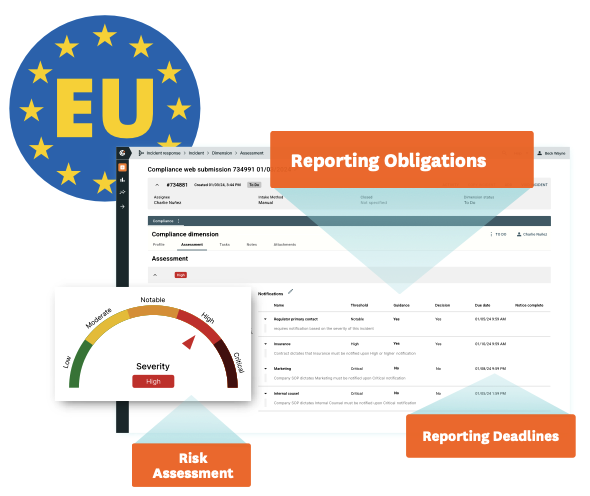
Risk Assessment and Reporting Obligations
The EU AI Act categorizes AI systems into four risk levels:
- Unacceptable Risk: AI systems that pose a clear threat
to safety, livelihoods, and rights of people. These
systems are prohibited effective February 1, 2025.
- High Risk: AI systems used in critical infrastructure, education, employment, law enforcement, and other sensitive areas are considered high risk and are subject to stringent rules. Providers of high-risk AI systems (HRAIS) have extensive obligations, including:
• Implementing risk management systems.
• Adhering to data governance measures.
• Ensuring record-keeping and transparency.
• Providing for human oversight.
• Establishing quality management systems.
• Monitoring post-market performance.
- Limited Risk: AI systems with specific transparency obligations, such as chatbots and virtual assistants.
- Minimal or No Risk: AI systems with minimal obligations, such as AI-enabled spam filters and video games.
General Purpose AI (GPAI)
Providers of GPAI models are subject to transparency obligations, including maintaining technical documentation and providing information to those integrating the models into their AI systems. GPAI models that pose systemic risks have additional requirements, such as:
- Stringent model evaluations
- Mitigating possible systemic risks
- Greater reporting obligations
- Ensuring adequate cybersecurity
- Reporting on energy efficiency
Compliance Risk Assessments with Radar® Compliance
As a trusted leader in risk management specializing in the automation of risk assessment for regulatory compliance, Radar® Compliance plays a crucial role in helping organizations navigate the complexities of the EU AI Act. The Act’s risk-based approach requires organizations to thoroughly assess and manage the risks associated with their AI systems.
RadarFirst’s expertise in risk assessment and reporting aligns perfectly with the needs of organizations seeking to comply with this regulation. By leveraging Radar® Compliance, companies can efficiently identify, evaluate, and mitigate risks associated with AI systems, ensuring adherence to the EU AI Act’s requirements.
Scenario: Incident Response Collaboration for Third-Party AI Threat
Consider a scenario in which a financial institution utilizes an AI-powered fraud detection system supplied by a third-party vendor. The AI system generates a high number of false positives, resulting in customer dissatisfaction and potential financial losses. The incident response team must collaborate to assess and resolve the threat.
First, the data privacy team assessed whether the AI’s false positives were causing unnecessary data processing or any breaches of customer privacy. They wanted to ensure that everything was handled according to the highest standards. The compliance team also became involved, evaluating the AI system’s adherence to the EU AI Act, with a particular focus on accuracy, transparency, and human oversight. Meanwhile, the cybersecurity team investigated whether the AI system had been compromised or if it was exhibiting anomalous behavior due to a cyberattack. They needed to rule out any security issues to ensure the system was safe.
To gain a comprehensive view of the risks, the teams utilized Radar Compliance to automate the risk assessment process. This tool helped them consider and document all relevant factors, including financial, reputational, and regulatory impacts.
The organization then engaged with the third-party vendor to address the AI system’s issues and implement the necessary fixes. Collaboration with the vendor was crucial to getting things back on track, and Radar® Compliance supported this process by offering a documented assessment of the situation.
Conclusion
The EU AI Act introduces a complex regulatory framework for organizations that utilize AI systems. Radar® Compliance offers valuable solutions for automating risk assessments, ensuring compliance, and mitigating potential penalties. By partnering with RadarFirst, organizations can confidently navigate the EU AI Act and leverage AI technologies responsibly and ethically.


