

Search Results
Found 534 results for: compliance
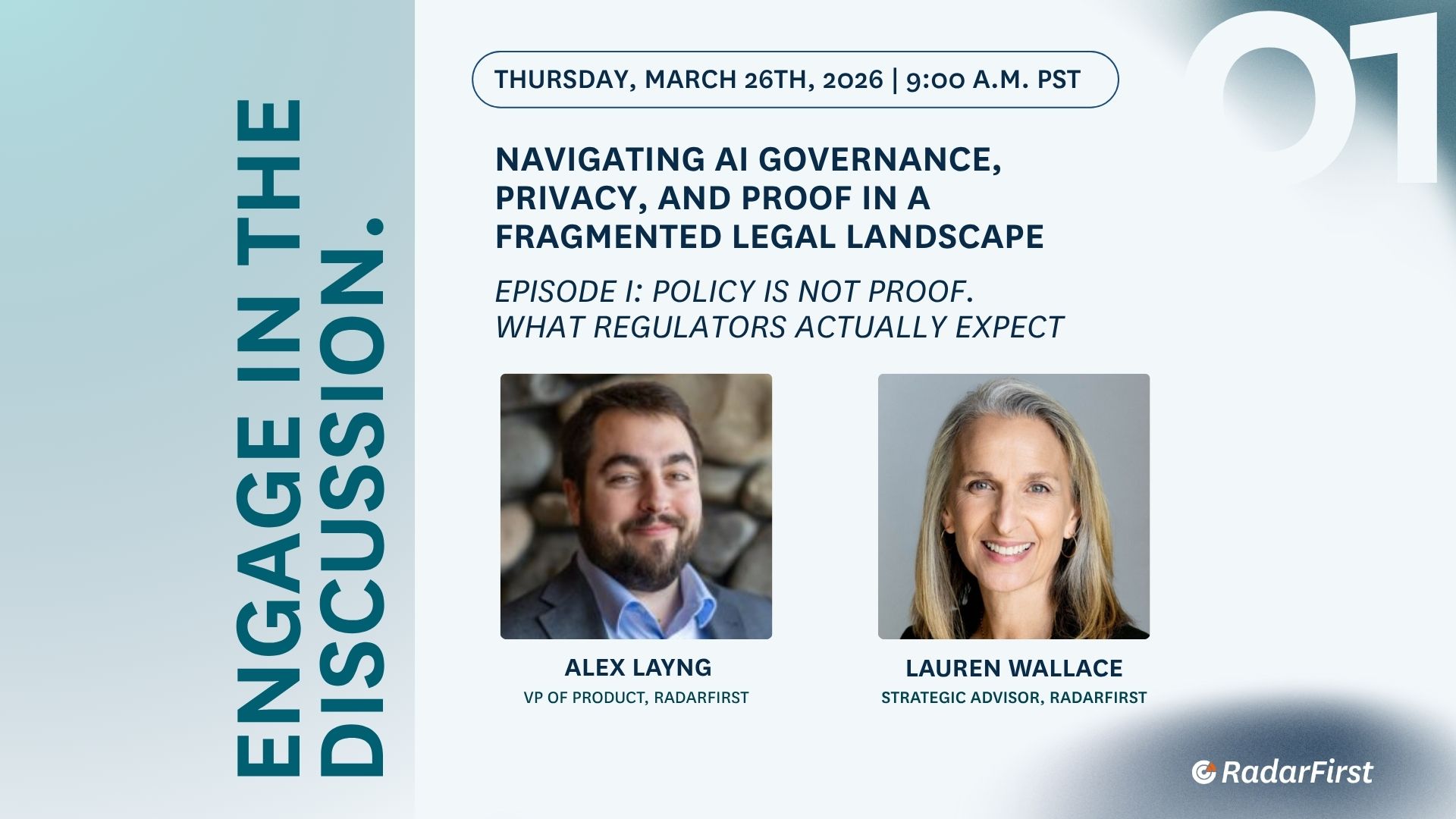
Episode I: Policy Is Not Proof. What Regulators Actually Expect
AI is outpacing compliance, and organizations must be ready to govern responsibly. Privacy professionals already have the skills to lead the charge—risk assessment, process standardization, and building trust with regulators. In this session, industry leaders Ron Whitworth (Truist) and Lauren Wallace (RadarFirst) reveal why privacy maturity is the launchpad for AI governance and how […]
Read More

Why the Future of Privacy Programs Requires a Unified Platform Approach
Privacy is no longer just about reacting to incidents. Organizations must now manage AI risk, data, and compliance in a continuous, connected way. A unified platform brings these efforts together, giving teams the visibility and control needed to operate efficiently and stay ahead of evolving regulations.
Read More

When Does the 30-Day Clock Start Under Regulation S-P? A Guide for Privacy Incident Management
When does the 30-day clock start under Regulation S-P? Learn how “awareness” drives privacy incident management and compliance timelines.
Read More
2026 Privacy Incident Benchmarking Report
Data-driven insights for privacy, compliance, legal, and IT risk leaders.
Read More

Colorado’s AI Policy Shift Signals a New Era: Why AI Incident Management Is Now a Regulatory Imperative
Colorado’s updated AI policy marks a shift from governance to accountability. As AI systems drive consequential decisions, failures are becoming regulatory events. Organizations must be prepared to detect, investigate, and respond to AI incidents to manage privacy risk and meet evolving compliance expectations.
Read More

Why AI Incident Management Must Evolve: Insights from NIST’s New Monitoring Report
[…] influenced by new data, changing environments, and user interactions. NIST’s AI 800-4 report outlines six distinct monitoring categories that organizations should consider: functionality, operational, human factors, security, compliance, and large-scale impacts. These categories reflect the multifaceted nature of responsible stewardship of an AI system. They also highlight why incidents can arise at many different […]
Read More

Where Broker-Dealers Will Operationally Fail Under Amended Regulation S-P
The amended Regulation S-P introduces a new layer of financial risk management for broker-dealers, centered on documented incident response, strict timelines, and defensible decision-making. The challenge is not compliance on paper. It is executing consistent, audit-ready risk management processes in practice.
Read More
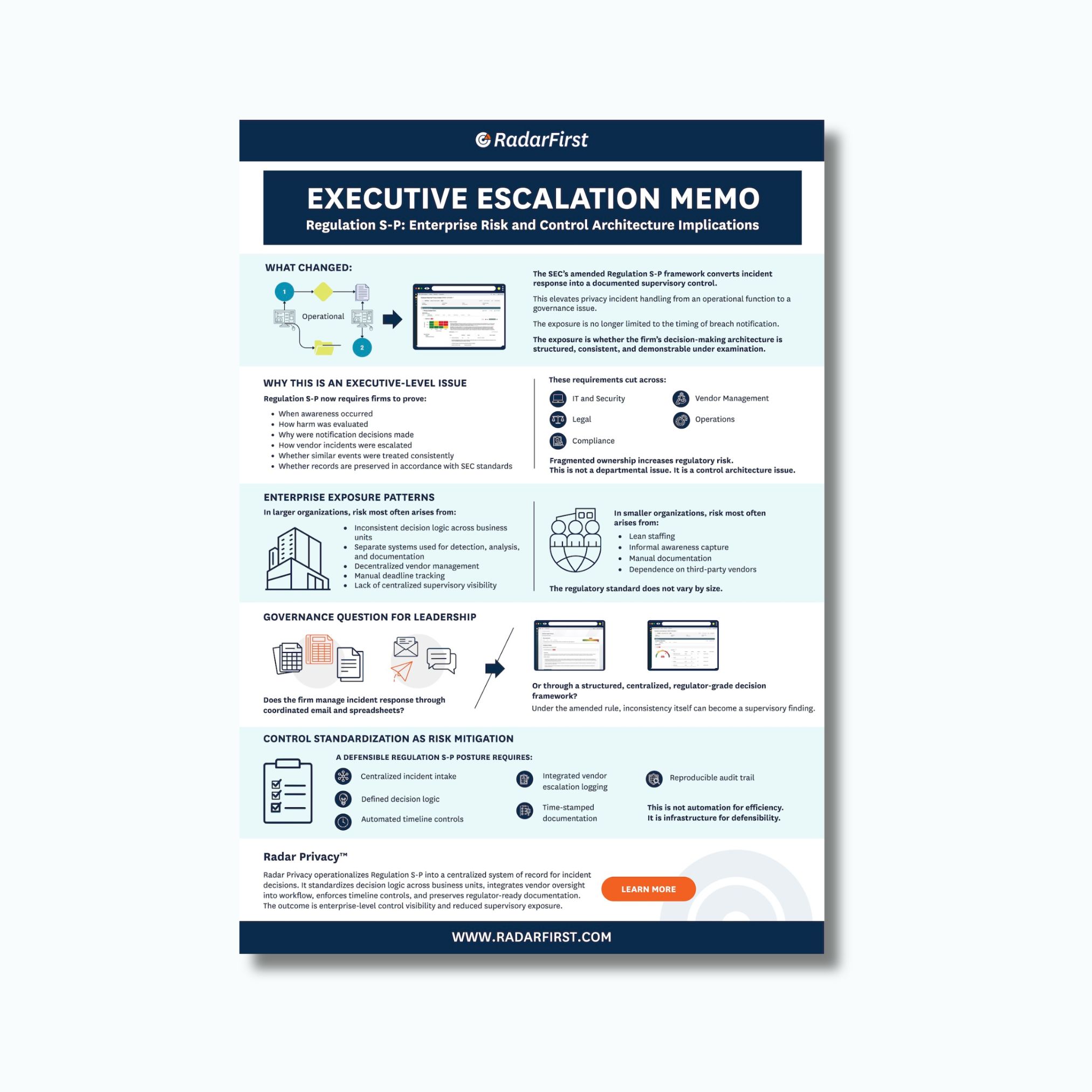
Reg S-P Executive Escalation Memo for Risk & Compliance
Reg S-P Executive Escalation Memo for Risk & Compliance Book Your Product Tour Understand enterprise risk, control gaps, and supervisory requirements under amended Regulation S-P. This executive escalation memo outlines how Regulation S-P elevates incident response to a governance issue, requiring structured, consistent, and defensible decision-making across the enterprise. Want to access the full […]
Read More
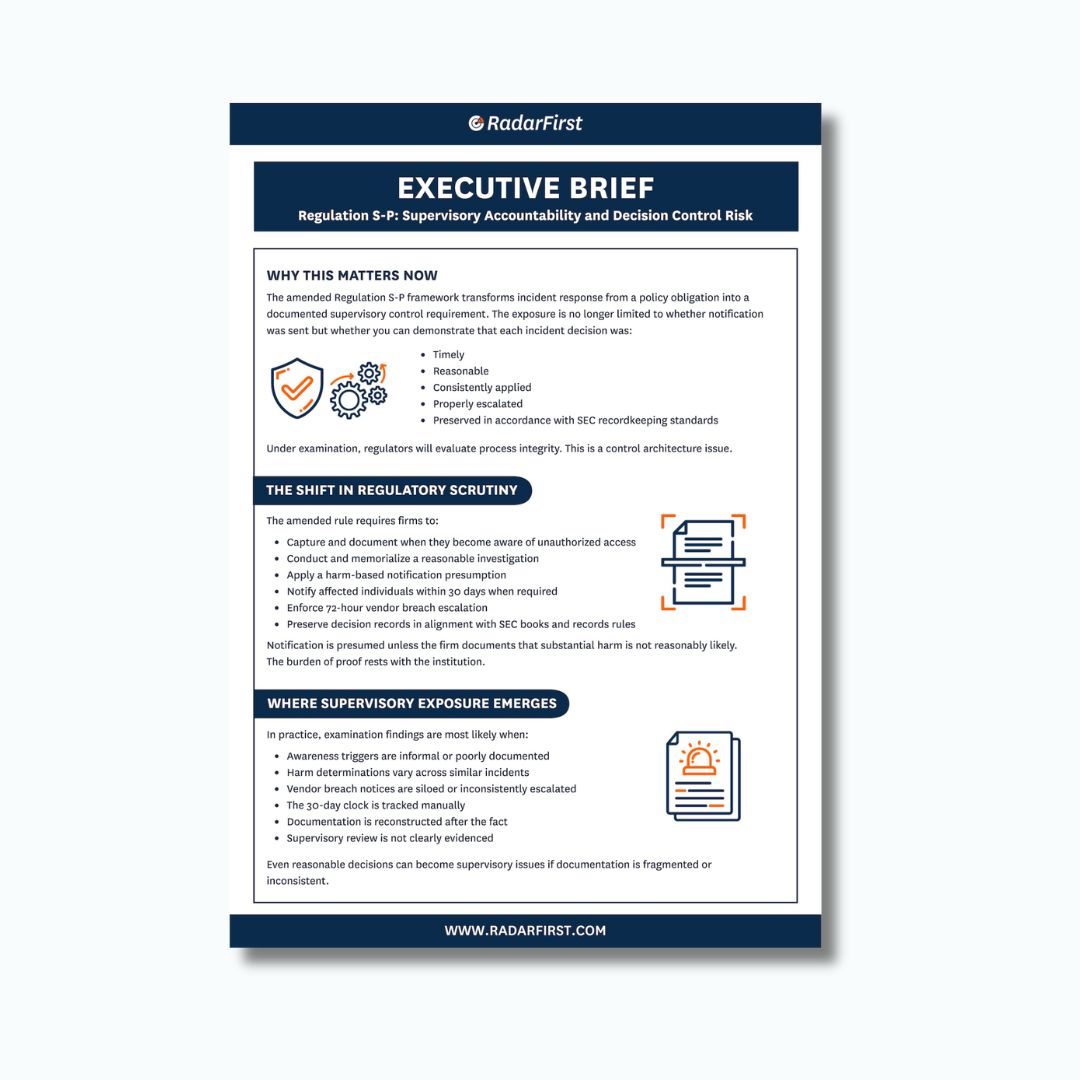
Reg S-P Executive Brief on Compliance Risk
Reg S-P Executive Brief on Compliance Risk Book Your Product Tour Explore Regulation S-P supervisory risks, decision consistency, and documentation requirements under the amended SEC rule. This executive brief outlines how amended Regulation S-P shifts focus to supervisory accountability, requiring firms to demonstrate consistent, documented, and defensible incident response decisions. Want to access the […]
Read More
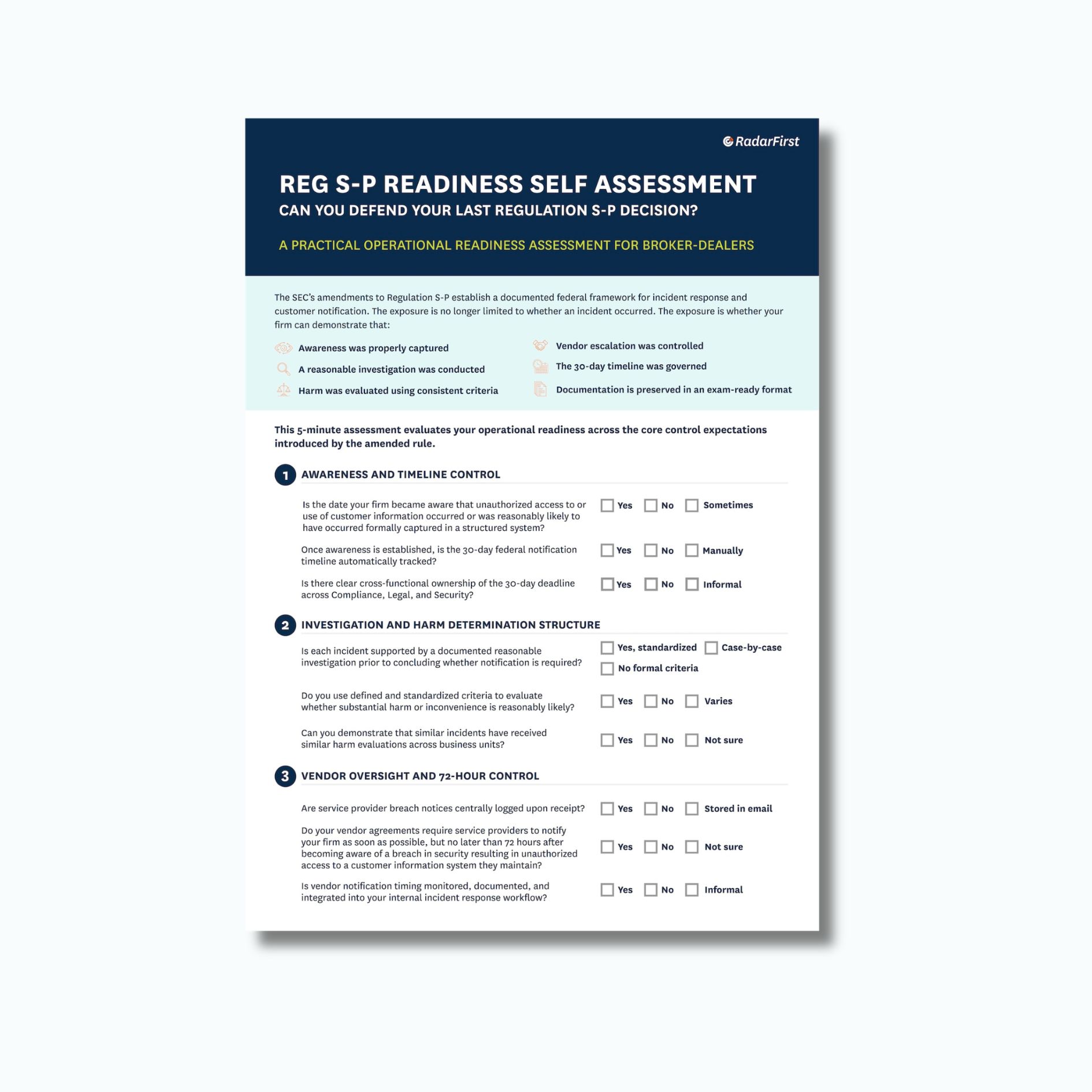
Reg S-P Readiness Self-Assessment for Broker-Dealers | SEC Compliance Checklist
Reg S-P Readiness Self-Assessment for Broker-Dealers | SEC Compliance Checklist Book Your Product Tour Can your firm defend its last Regulation S-P decision? This practical self-assessment helps broker-dealers evaluate incident response readiness, harm determination, vendor oversight, and documentation practices under the SEC’s amended rule Want to access the full guide? Download PDF Get Your […]
Read More

Navigating Elevated Cyber Risk. The Regulatory Decision Layer of Incident Management
[…] regulatory and public scrutiny. Healthcare organizations, for example, hold highly sensitive protected health information. In times of geopolitical tension, even unverified breach claims can create reputational and compliance pressure. Privacy teams must quickly determine whether an alleged incident is substantiated and whether regulatory thresholds are met. At the same time, new regulations worldwide are […]
Read More

HIPAA, AI Incident Management, and Privacy Tools for Compliance Leaders
As federal agencies explore using AI to detect and prevent healthcare fraud, privacy and compliance leaders face a critical reality. Innovation cannot come at the expense of protected health information. AI systems rely on vast amounts of claims, billing, and patient data, which means privacy incident management must evolve beyond traditional breach response. For […]
Read More

The Amended Regulation S-P Incident Response Framework: From Awareness to Defensible Documentation
The SEC’s amendments to Regulation S-P transform incident management from a policy exercise into a documented control function. The amended Reg S-P requirements require firms to log awareness triggers, conduct and memorialize reasonable investigations, apply a defensible harm determination, oversee vendor notifications within 72 hours, and meet the 30 day federal notification timeline. Each step […]
Read More

AI in Healthcare Fraud Detection: What It Means for Privacy and Compliance Leaders
As federal agencies explore using AI to detect and prevent healthcare fraud, privacy and compliance leaders face a critical reality. Innovation cannot come at the expense of protected health information. AI systems rely on vast amounts of claims, billing, and patient data, which means privacy incident management must evolve beyond traditional breach response. For […]
Read More

Why Privacy Incident Management and AI Risk Response Are Now Central to Trust and Compliance
[…] now includes AI driven harms, automated decisions, and model accountability. Organizations need integrated privacy and AI incident management built on strong data governance and clear workflows. Regulators expect operational readiness, not just written policies. Those who unify privacy and AI response will reduce risk, strengthen compliance, and build trust in a rapidly changing regulatory environment.
Read More
Found 534 results for: compliance
Episode I: Policy Is Not Proof. What Regulators Actually Expect
AI is outpacing compliance, and organizations must be ready to govern responsibly. Privacy professionals already have the skills to lead the charge—risk assessment, process standardization, and building trust with regulators. In this session, industry leaders Ron Whitworth (Truist) and Lauren Wallace (RadarFirst) reveal why privacy maturity is the launchpad for AI governance and how […]
Read More Why the Future of Privacy Programs Requires a Unified Platform Approach
Privacy is no longer just about reacting to incidents. Organizations must now manage AI risk, data, and compliance in a continuous, connected way. A unified platform brings these efforts together, giving teams the visibility and control needed to operate efficiently and stay ahead of evolving regulations.
Read More When Does the 30-Day Clock Start Under Regulation S-P? A Guide for Privacy Incident Management
When does the 30-day clock start under Regulation S-P? Learn how “awareness” drives privacy incident management and compliance timelines.
Read More 2026 Privacy Incident Benchmarking Report
Data-driven insights for privacy, compliance, legal, and IT risk leaders.
Read More Colorado’s AI Policy Shift Signals a New Era: Why AI Incident Management Is Now a Regulatory Imperative
Colorado’s updated AI policy marks a shift from governance to accountability. As AI systems drive consequential decisions, failures are becoming regulatory events. Organizations must be prepared to detect, investigate, and respond to AI incidents to manage privacy risk and meet evolving compliance expectations.
Read More Why AI Incident Management Must Evolve: Insights from NIST’s New Monitoring Report
[…] influenced by new data, changing environments, and user interactions. NIST’s AI 800-4 report outlines six distinct monitoring categories that organizations should consider: functionality, operational, human factors, security, compliance, and large-scale impacts. These categories reflect the multifaceted nature of responsible stewardship of an AI system. They also highlight why incidents can arise at many different […]
Read More Where Broker-Dealers Will Operationally Fail Under Amended Regulation S-P
The amended Regulation S-P introduces a new layer of financial risk management for broker-dealers, centered on documented incident response, strict timelines, and defensible decision-making. The challenge is not compliance on paper. It is executing consistent, audit-ready risk management processes in practice.
Read More Reg S-P Executive Escalation Memo for Risk & Compliance
Reg S-P Executive Escalation Memo for Risk & Compliance Book Your Product Tour Understand enterprise risk, control gaps, and supervisory requirements under amended Regulation S-P. This executive escalation memo outlines how Regulation S-P elevates incident response to a governance issue, requiring structured, consistent, and defensible decision-making across the enterprise. Want to access the full […]
Read More Reg S-P Executive Brief on Compliance Risk
Reg S-P Executive Brief on Compliance Risk Book Your Product Tour Explore Regulation S-P supervisory risks, decision consistency, and documentation requirements under the amended SEC rule. This executive brief outlines how amended Regulation S-P shifts focus to supervisory accountability, requiring firms to demonstrate consistent, documented, and defensible incident response decisions. Want to access the […]
Read More Reg S-P Readiness Self-Assessment for Broker-Dealers | SEC Compliance Checklist
Reg S-P Readiness Self-Assessment for Broker-Dealers | SEC Compliance Checklist Book Your Product Tour Can your firm defend its last Regulation S-P decision? This practical self-assessment helps broker-dealers evaluate incident response readiness, harm determination, vendor oversight, and documentation practices under the SEC’s amended rule Want to access the full guide? Download PDF Get Your […]
Read More Navigating Elevated Cyber Risk. The Regulatory Decision Layer of Incident Management
[…] regulatory and public scrutiny. Healthcare organizations, for example, hold highly sensitive protected health information. In times of geopolitical tension, even unverified breach claims can create reputational and compliance pressure. Privacy teams must quickly determine whether an alleged incident is substantiated and whether regulatory thresholds are met. At the same time, new regulations worldwide are […]
Read More HIPAA, AI Incident Management, and Privacy Tools for Compliance Leaders
As federal agencies explore using AI to detect and prevent healthcare fraud, privacy and compliance leaders face a critical reality. Innovation cannot come at the expense of protected health information. AI systems rely on vast amounts of claims, billing, and patient data, which means privacy incident management must evolve beyond traditional breach response. For […]
Read More The Amended Regulation S-P Incident Response Framework: From Awareness to Defensible Documentation
The SEC’s amendments to Regulation S-P transform incident management from a policy exercise into a documented control function. The amended Reg S-P requirements require firms to log awareness triggers, conduct and memorialize reasonable investigations, apply a defensible harm determination, oversee vendor notifications within 72 hours, and meet the 30 day federal notification timeline. Each step […]
Read More AI in Healthcare Fraud Detection: What It Means for Privacy and Compliance Leaders
As federal agencies explore using AI to detect and prevent healthcare fraud, privacy and compliance leaders face a critical reality. Innovation cannot come at the expense of protected health information. AI systems rely on vast amounts of claims, billing, and patient data, which means privacy incident management must evolve beyond traditional breach response. For […]
Read More Why Privacy Incident Management and AI Risk Response Are Now Central to Trust and Compliance
[…] now includes AI driven harms, automated decisions, and model accountability. Organizations need integrated privacy and AI incident management built on strong data governance and clear workflows. Regulators expect operational readiness, not just written policies. Those who unify privacy and AI response will reduce risk, strengthen compliance, and build trust in a rapidly changing regulatory environment.
Read More← Back to Search