

Search Results
Found 654 results for: privacy

Key Trends in AI Governance: Insights from IAPP GPS 2026
At IAPP Global Privacy Summit 2025, a clear shift emerged as organizations prioritize AI governance, privacy, and safety over pure productivity. As AI systems grow more complex, experts stress that proactive governance is now a critical business priority.
Read More
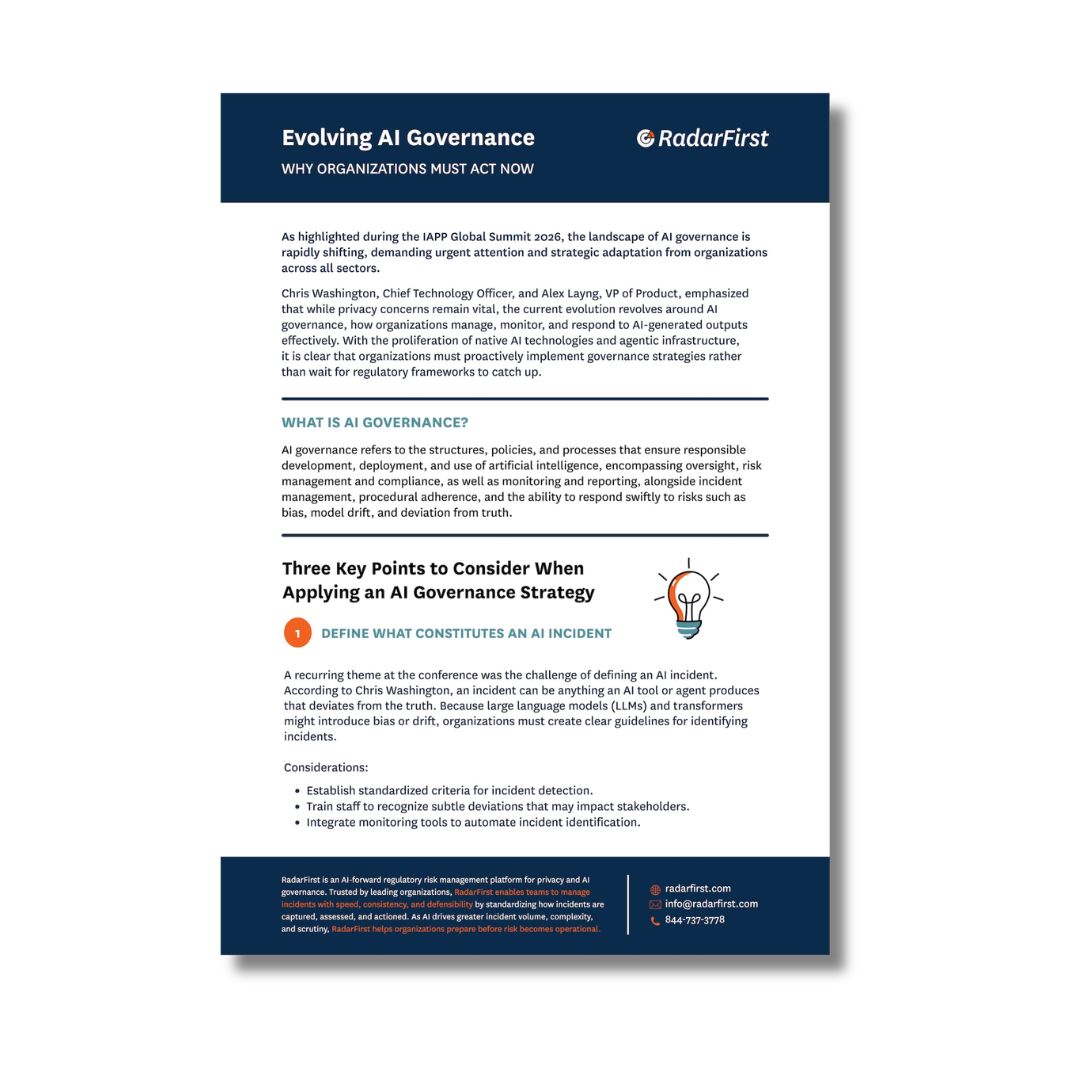
2026 IAPP GPS Key Takeaways
Chris Washington, Chief Technology Officer, and Alex Layng, VP of Product, highlighted a shift from traditional privacy concerns to a broader focus on AI governance, emphasizing the need for organizations to actively manage and monitor AI-generated outputs. As native AI technologies and agentic systems rapidly expand, they stressed that companies must implement proactive governance […]
Read More
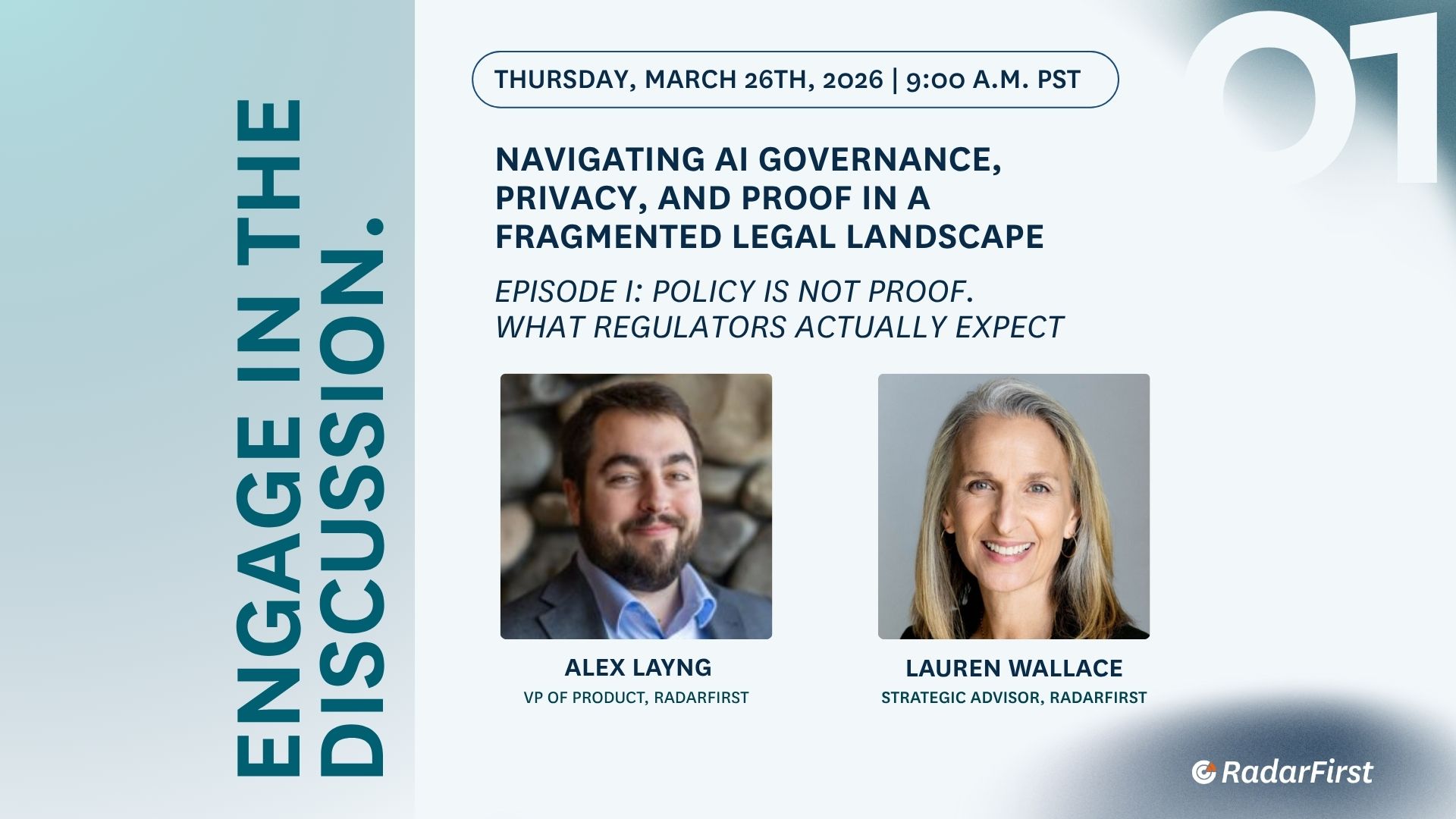
Episode I: Policy Is Not Proof. What Regulators Actually Expect
AI is outpacing compliance, and organizations must be ready to govern responsibly. Privacy professionals already have the skills to lead the charge—risk assessment, process standardization, and building trust with regulators. In this session, industry leaders Ron Whitworth (Truist) and Lauren Wallace (RadarFirst) reveal why privacy maturity is the launchpad for AI governance and how […]
Read More

Why the Future of Privacy Programs Requires a Unified Platform Approach
Privacy is no longer just about reacting to incidents. Organizations must now manage AI risk, data, and compliance in a continuous, connected way. A unified platform brings these efforts together, giving teams the visibility and control needed to operate efficiently and stay ahead of evolving regulations.
Read More

When Does the 30-Day Clock Start Under Regulation S-P? A Guide for Privacy Incident Management
When does the 30-day clock start under Regulation S-P? Learn how “awareness” drives privacy incident management and compliance timelines.
Read More
2026 Privacy Incident Benchmarking Report
Data-driven insights for privacy, compliance, legal, and IT risk leaders.
Read More

Colorado’s AI Policy Shift Signals a New Era: Why AI Incident Management Is Now a Regulatory Imperative
Colorado’s updated AI policy marks a shift from governance to accountability. As AI systems drive consequential decisions, failures are becoming regulatory events. Organizations must be prepared to detect, investigate, and respond to AI incidents to manage privacy risk and meet evolving compliance expectations.
Read More

Why AI Incident Management Must Evolve: Insights from NIST’s New Monitoring Report
NIST’s latest privacy engineering efforts reinforce a key shift. Privacy must be embedded into risk management, not treated as a standalone function. Here’s what that means for today’s teams.
Read More
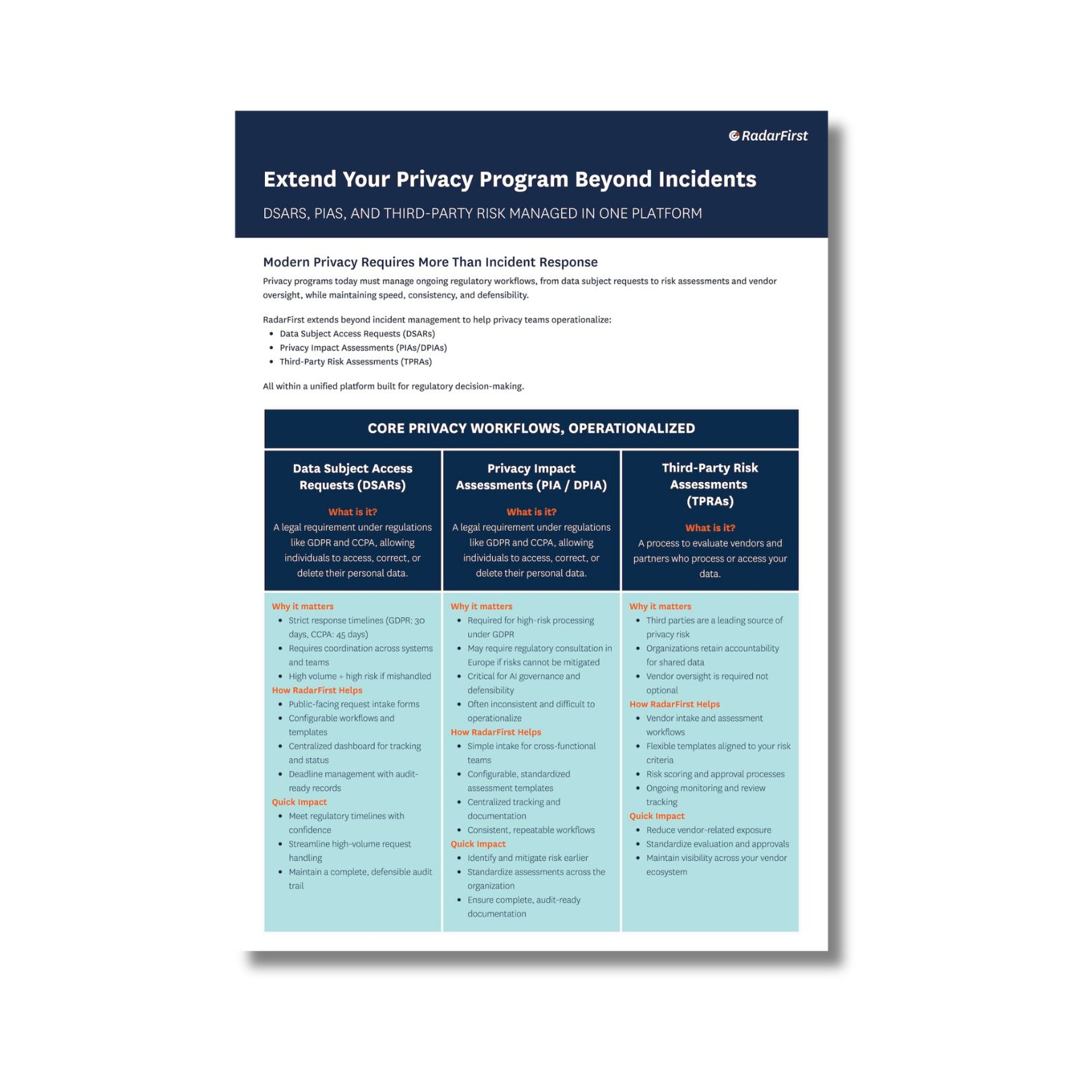
Privacy Workflow Platform for DSARs, PIAs & Vendor Risk
Modern privacy programs require more than incident response. This guide shows how to operationalize DSARs, PIAs, and third-party risk assessments within a unified, defensible platform.
Read More

Where Broker-Dealers Will Operationally Fail Under Amended Regulation S-P
[…] financial risk management and regulatory risk management perspective, this shift is significant. In 2024, the SEC adopted major amendments to Regulation S-P, transforming it from a safeguards-focused privacy rule into a documented federal incident response and notification regime with defined timelines, harm standards, vendor escalation requirements, and recordkeeping obligations. For broker-dealers and other covered […]
Read More

Navigating Elevated Cyber Risk. The Regulatory Decision Layer of Incident Management
[…] cyber threats escalate amid global conflict, organizations face growing pressure to determine whether security events involve personal data and trigger regulatory obligations. While security tools detect incidents, privacy and legal teams must assess regulatory impact, document decisions and manage notification requirements. Structured privacy incident management helps organizations move from technical alerts to defensible regulatory […]
Read More

HIPAA, AI Incident Management, and Privacy Tools for Compliance Leaders
As federal agencies explore using AI to detect and prevent healthcare fraud, privacy and compliance leaders face a critical reality. Innovation cannot come at the expense of protected health information. AI systems rely on vast amounts of claims, billing, and patient data, which means privacy incident management must evolve beyond traditional breach response. For […]
Read More

The Amended Regulation S-P Incident Response Framework: From Awareness to Defensible Documentation
[…] federal notification timeline. Each step must be supported by structured documentation that demonstrates when decisions were made, by whom, and based on what facts. As firms modernize privacy incident management programs, many are turning to governed AI incident management workflows to standardize intake, enforce timelines, and preserve audit ready records. Under amended Reg S-P, […]
Read More

AI in Healthcare Fraud Detection: What It Means for Privacy and Compliance Leaders
As federal agencies explore using AI to detect and prevent healthcare fraud, privacy and compliance leaders face a critical reality. Innovation cannot come at the expense of protected health information. AI systems rely on vast amounts of claims, billing, and patient data, which means privacy incident management must evolve beyond traditional breach response. For […]
Read More

Why Privacy Incident Management and AI Risk Response Are Now Central to Trust and Compliance
As AI legislation expands and privacy enforcement intensifies, incident response is evolving. It is no longer just about data breaches. It now includes AI driven harms, automated decisions, and model accountability. Organizations need integrated privacy and AI incident management built on strong data governance and clear workflows. Regulators expect operational readiness, not just written […]
Read More
Found 654 results for: privacy
Key Trends in AI Governance: Insights from IAPP GPS 2026
At IAPP Global Privacy Summit 2025, a clear shift emerged as organizations prioritize AI governance, privacy, and safety over pure productivity. As AI systems grow more complex, experts stress that proactive governance is now a critical business priority.
Read More 2026 IAPP GPS Key Takeaways
Chris Washington, Chief Technology Officer, and Alex Layng, VP of Product, highlighted a shift from traditional privacy concerns to a broader focus on AI governance, emphasizing the need for organizations to actively manage and monitor AI-generated outputs. As native AI technologies and agentic systems rapidly expand, they stressed that companies must implement proactive governance […]
Read More Episode I: Policy Is Not Proof. What Regulators Actually Expect
AI is outpacing compliance, and organizations must be ready to govern responsibly. Privacy professionals already have the skills to lead the charge—risk assessment, process standardization, and building trust with regulators. In this session, industry leaders Ron Whitworth (Truist) and Lauren Wallace (RadarFirst) reveal why privacy maturity is the launchpad for AI governance and how […]
Read More Why the Future of Privacy Programs Requires a Unified Platform Approach
Privacy is no longer just about reacting to incidents. Organizations must now manage AI risk, data, and compliance in a continuous, connected way. A unified platform brings these efforts together, giving teams the visibility and control needed to operate efficiently and stay ahead of evolving regulations.
Read More When Does the 30-Day Clock Start Under Regulation S-P? A Guide for Privacy Incident Management
When does the 30-day clock start under Regulation S-P? Learn how “awareness” drives privacy incident management and compliance timelines.
Read More 2026 Privacy Incident Benchmarking Report
Data-driven insights for privacy, compliance, legal, and IT risk leaders.
Read More Colorado’s AI Policy Shift Signals a New Era: Why AI Incident Management Is Now a Regulatory Imperative
Colorado’s updated AI policy marks a shift from governance to accountability. As AI systems drive consequential decisions, failures are becoming regulatory events. Organizations must be prepared to detect, investigate, and respond to AI incidents to manage privacy risk and meet evolving compliance expectations.
Read More Why AI Incident Management Must Evolve: Insights from NIST’s New Monitoring Report
NIST’s latest privacy engineering efforts reinforce a key shift. Privacy must be embedded into risk management, not treated as a standalone function. Here’s what that means for today’s teams.
Read More Privacy Workflow Platform for DSARs, PIAs & Vendor Risk
Modern privacy programs require more than incident response. This guide shows how to operationalize DSARs, PIAs, and third-party risk assessments within a unified, defensible platform.
Read More Where Broker-Dealers Will Operationally Fail Under Amended Regulation S-P
[…] financial risk management and regulatory risk management perspective, this shift is significant. In 2024, the SEC adopted major amendments to Regulation S-P, transforming it from a safeguards-focused privacy rule into a documented federal incident response and notification regime with defined timelines, harm standards, vendor escalation requirements, and recordkeeping obligations. For broker-dealers and other covered […]
Read More Navigating Elevated Cyber Risk. The Regulatory Decision Layer of Incident Management
[…] cyber threats escalate amid global conflict, organizations face growing pressure to determine whether security events involve personal data and trigger regulatory obligations. While security tools detect incidents, privacy and legal teams must assess regulatory impact, document decisions and manage notification requirements. Structured privacy incident management helps organizations move from technical alerts to defensible regulatory […]
Read More HIPAA, AI Incident Management, and Privacy Tools for Compliance Leaders
As federal agencies explore using AI to detect and prevent healthcare fraud, privacy and compliance leaders face a critical reality. Innovation cannot come at the expense of protected health information. AI systems rely on vast amounts of claims, billing, and patient data, which means privacy incident management must evolve beyond traditional breach response. For […]
Read More The Amended Regulation S-P Incident Response Framework: From Awareness to Defensible Documentation
[…] federal notification timeline. Each step must be supported by structured documentation that demonstrates when decisions were made, by whom, and based on what facts. As firms modernize privacy incident management programs, many are turning to governed AI incident management workflows to standardize intake, enforce timelines, and preserve audit ready records. Under amended Reg S-P, […]
Read More AI in Healthcare Fraud Detection: What It Means for Privacy and Compliance Leaders
As federal agencies explore using AI to detect and prevent healthcare fraud, privacy and compliance leaders face a critical reality. Innovation cannot come at the expense of protected health information. AI systems rely on vast amounts of claims, billing, and patient data, which means privacy incident management must evolve beyond traditional breach response. For […]
Read More Why Privacy Incident Management and AI Risk Response Are Now Central to Trust and Compliance
As AI legislation expands and privacy enforcement intensifies, incident response is evolving. It is no longer just about data breaches. It now includes AI driven harms, automated decisions, and model accountability. Organizations need integrated privacy and AI incident management built on strong data governance and clear workflows. Regulators expect operational readiness, not just written […]
Read More← Back to Search